Archive

Archive for October, 2009

Happy Hallo-Weenie – From Dirty Coal

October 30th, 2009 Bill Wolfe No comments

Why are national “environmental groups” supporting new coal power plants and so called  “clean coal technology”?

Senate Environment Committee Chair Barbara Boxer

Senate Environment Committee Chair Barbara Boxer

I refer to Senate testimony yesterday by Environmental Defense Fund (EDF) and Natural Resources Defense Council (NRDC) in support of the so called “clean coal technology” incentives in the Kerry Senate global warming bill:

Here’s the testimony of NRDC:

“If we decide to do it, the U.S. and the world could build and operate new coal plants so that their CO2 is returned to the ground rather than polluting the atmosphere. S. 1733 contains a comprehensive approach to make this happen in the U.S.... We also recommend that proposed section 122 (a) specifically state that the regulations promulgated by the Administrator will apply at a minimum to hydrocarbon reservoirs and deep saline formations.”

NRDC supports “new coal plants” in the US? WTF!

Here’s the testimony of corporate market tool promoting EDF:

“After taking stock of the macroeconomic evidence, I then hone in on two particular areas that could make major contributions to achieving our goals: energy efficiency and carbon capture and storage. (Carbon capture and storage, or “CCS,” means capturing carbon dioxide at power plants or factories and pumping it into underground geological formations for long-term storage.) Each of these areas can dramatically reduce emissions while creating jobs and establishing American technological leadership.”

EDF’s embrace of market tools has become a fetish – the means now justify the ends in EDF’s corporate worldview.
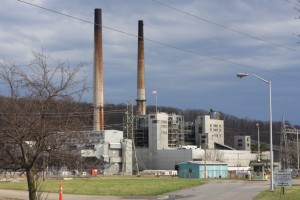
coal power -

Reliant Energy - Portland Coal Plant, Pa.

According to Senate Environment Committee Chair Barbara Boxer (D-Ca.), the new so called “clean coal technology” provisions would:

o The Chairman’s Mark includes new provisions to stimulate development of commercial-scale carbon capture and sequestration (CCS) technologies
o The bonus allowance program is modified to allow for advanced payments of bonus allowances for early actors with a requirement that funded projects will achieve at least a 50% reduction in greenhouse gas emissions.
o The Chairman’s Mark includes provisions that require coal fired power plants to meet emissions performance standards once sufficient commercial-scale CCS technology has been deployed, while also ensuring timely reductions in global warming pollution from coal plants.

It’s no surprise that the Democratic Party is in the pocket of Big Coal.

Even Al Gore pulled his punch on the coal industry’s big lie that there’s such a thing as “clean coal” – calling it a lie equivalent to safe cigarettes – by allowing a bogus exemption for coal burning with “carbon capture and storage” (CCS) (which NRDC now admits is “disposal” technology, or CCD – “carbon capture and disposal“)

Despite the recent rejection of a $5 billion new coal plant with CCS proposed in Linden, NJ, according to Peter Montague, the Kerry bill would provide huge taxpayer giveaways:

According to this summary of Senator John Kerry’s bill, S. 1733, as
the bill is written, PurGen would be eligible for a “bonus allowance”
(a cash payment from taxpayers) of $96 per ton of CO2 buried, plus
another $10 per ton if they start operating before 2017. PurGen plans
to start operating in 2015. So if PurGen meets its startup date, it
will be eligible for a federal subsidy of $106 per ton of CO2 buried,
assuming Kerry’s bill passes House and Senate.

Because PurGen plans to bury 10 million tons of CO2 per year, their
annual subsidy would be $1.06 billion each year. Over a 50-year
period, their subsidy would total $53 billion.

CCS would perpetuate the coal energy economy and is a huge technological boondoggle. It has no place in the mix of policy tools to fight global warming.

Both Al Gore and world renowned NASA scientist  Dr. James Hansen have called for civil disobedience to shut down coal plants and end mountain top removal coal mining practices.

There are faster, cheaper, cleaner and more job producing solutions to the global warming crisis – efficiency and renewables.

The last thing we need are so called “environmental groups” cheerleading for a false technological magic bullet.

the answer is blowin' in the wind

the answer is blowin' in the wind - Columbia River Plateau, Oregon
Categories: Uncategorized Tags:

EPA School Air Toxics Data Misleading

October 29th, 2009 Bill Wolfe No comments
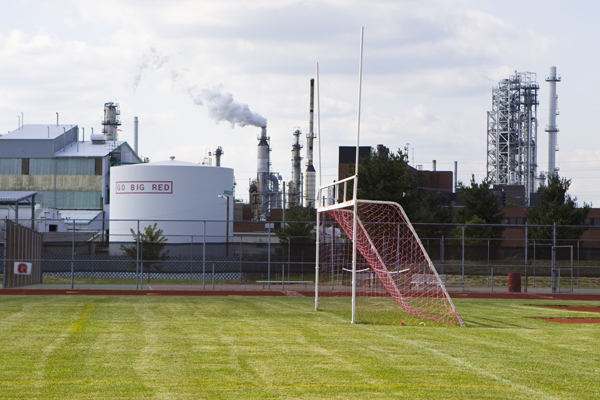
Paulsboro High School - Valero refinery and chemical plant in background. Note direction of plume from stack - pollution is being blown directly toward schoo. I could strongly smell volatile organci chemicals. After just 15 minutes shooting these pictures, I was nauseasous and had a headache and dry scratchy throat, pl

Paulsboro High School - Valero refinery and Air Products chemical plant in background. Note the direction of plume from stack - pollution is being blown directly toward school. I could strongly smell volatile organic chemicals. After just 15 minutes shooting these pictures, I was nauseous and had a headache and dry scratchy throat.

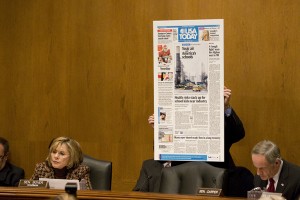
Senate Envrionment Committee Chair Barbara Boxer (D-Ca.) questions EPA Administrator Jackson at confirtmation hearings about kid's exposure to toxics at school, as documentd by USA Today series.

Senate Envrionment Committee Chair Barbara Boxer (D-Ca.) questions Lisa Jackson at EPA confirmation hearing about kid's exposure to toxics at school, as documented by USA Today series.

EPA today released interim air toxics monitoring results at two NJ schools participating in a new national program that is monitoring air quality around 63 schools in 22 states.The new EPA  program was a response to major investigative reports by the Houston Chronicle (”In Harm’s Way”) and USA Today (”Toxic Air and America’s Schools”) that documented serious health threats due to exposure to toxic air pollutants, particularly to children from chemical plants and refineries located close to schools (read this for background) and (this for Senator Boxer’s commitment at EPA Administrator Jackson’s confirmation hearing)

The initial NJ results are misleading.

Valero refinery emits toxic air pollutants, just feet upwind from Paulsboro high school

Valero refinery emits toxic air pollutants, just feet upwind from Paulsboro high school

First off, if you read the EPA press release below, you wouldn’t know that the NJ schools (Paulsboro High School and Mabel Holmes Middle School in Elizabeth) are located very close to and virtually surrounded by chemical plants and refineries that emit thousands of pounds of volatile organic toxic air pollutants to the local air.

Second, if you looked at the initial sample results, you might conclude that everything is OK – , until you realize that EPA sampled mostly for heavy metals, not volatile organic compounds (VOC’s) and chemicals emitted by the chemical plants and refineries. Those VOC pollutants are “yet to be monitored” according to EPA. EPA sampled for

Antimony (Nanograms/cubic meter) 2000 4.08
Arsenic (Nanograms/cubic meter) 150 .71
Beryllium (Nanograms/cubic meter) 20 .06
Cadmium (Nanograms/cubic meter) 30 .15
Cobalt (Nanograms/cubic meter) 100 .27
Formaldehyde (Micrograms/cubic meter) 50 3.23207 2.96171 5.05088
Manganese (Nanograms/cubic meter) 500 8.51
Mercury (Nanograms/cubic meter) 3000 .02
Propionaldehyde (Micrograms/cubic meter) 80 .38742 .43971 .65125
Selenium

This is especially troubling, because not only do these results mislead the public by creating a false appearance that there is no problem, but the results will be used by EPA “to help determine next steps, which could include more monitoring, if needed”.

That’s right – EPA could say that based on these results, there is no problem and no further sampling, permit modification, or enforcement to reduce pollution are required.

Air Products chemical plant just feet away from Paulsboro High School. Prevailing westerly winds blow toxic pollution from this plant directly into school.

Air Products chemical plant just feet away from Paulsboro High School. Prevailing westerly winds blow toxic pollution from this plant directly into school.

The lies and excuses have already been framed to spin this data. First, the oil and chemical industries are suggesting that the risk are negligible and the sources of pollutants are mobile sources – cars and trucks. We doubt the EPA sampling protocol will be able to distinguish between sources, so EPA is not challenging this lie. Worse, these facilities are issued permits under the Clean Air Act, so EPA knows exactly what hazardous air pollutants are being emitted by those facilities. These hazardous air pollutants should have been targeted and the first ones sampled, not metals. Second, EPA – as per below press release – will stress chronic long term exposure risks to downplay the risks of any high level local VOC results.

We Await the VOC monitoring.

Update:

I just looked at the full list of EPA monitored pollutants at schools. EPA is monitoring for just 3 VOC’s! This is a pathetic whitewash – the Clean Air Act regulates 187 chemicals as hazardous air pollutants – check out EPA’s June 2009 National ambient air toxics data and statewide NJ cancer risks here). As I suspected, the few pollutants EPA is monitoring all involve naturally occurring sources of pollution, or are related to vehicle exhaust or mobile sources. This seems designed to allow the chemical & oil industries to make the argument that industry emissions are not the problem and to point the finger at mobile sources and naturally occurring sources. EPA could have considered the hazardous air pollutants emitted by nearby refinery and chemical plants (in EPA air permit data), and then designed a monitoring scheme that included those pollutants. That way, EPA would have a solid scientific basis to modify air permits to force facilities to reduce their emissions, based on impacts to nearby schools. But EPA DID NOT DO THIS! What a sham! Check out the EPA short list of VOC’s

Paulsboro HS can be seen in background. Rail cars store extraordianrily toxic chemciclas neaby. AIr Products plant on left. Note plume of emissions from stack on far left. The wind is blowing right towards high school.

Paulsboro HS can be seen in background (center). Rail cars store extraordinarily toxic chemicals nearby (right). Air Products plant (left). Note plume of emissions from stack on far left. The wind is blowing it towards high school.

Here’s today’s EPA press release:

Who's celebrating?

Who's celebrating?

The first results from ongoing air toxics monitoring at two New Jersey schools and one New York school are now available on the U.S. Environmental Protection Agency’s (EPA) Web site. A total of four schools in EPA’s Region 2 were selected as part of the agency’s national Schools Air Toxics Initiative. The initiative, which is monitoring 63 schools in 22 states, will help EPA and the states learn if long-term exposure to toxics in the outdoor air poses health concerns for school children and staff.

Outdoor air at the schools is being monitored for 60 days, and air quality monitors will collect at least 10 daily samples during the sampling period. EPA will use this information to help determine next steps, which could include more monitoring, if needed. Results are posted at http://www.epa.gov/schoolair.

Today, EPA is posting data for Olean Middle School in Olean, New York, Mabel Homes Middle School in Elizabeth, N.J. and Paulsboro High School in Paulsboro, N.J. The fourth school, IS 143 in Manhattan, New York, had its first data posted previously and it is also available at the web site.  The Agency is monitoring the air around these schools for several contaminants associated with industrial and mobile sources such as cars, trucks and airplanes.

Did Big Oil design EPA school sampling program?

Did Big Oil design EPA school sampling program?

Early sampling at all the schools show that levels of air toxics are below levels of short-term concern. EPA scientists warn against drawing conclusions at this point since the project is designed to show if long-term, not short-term, exposure poses health risks to school children and staff. Once monitoring is complete, the full set of results from all of the schools will be evaluated for potential health concerns from long-term exposure to these pollutants. EPA will post this analysis to the Web once it is complete.

To learn more about EPA’s efforts to study outdoor air near schools, visit: http://www.epa.gov/schoolair

Categories: Uncategorized Tags:

If There Is a God, Thank Her for Chris Hedges

October 26th, 2009 Bill Wolfe No comments

Chris Hedges is a writer – his books and columns probe decadence, war, fascism, and cynicism and devastate the moral conscience. He writes a weekly column that appears on Monday’s at Truthdig.com Below is today’s superb column (printed in its entirety without permission, but I doubt he’ll sue me for it).   Thank you Mr. Hedges. How did everyone else miss the perverse cynicism of linking the Pentagon’s war budget to a hate crimes bill?

War Is a Hate Crime

Posted on Oct 26, 2009
AP / Rafiq Maqbool

A U.S. soldier walks in the snow at an outpost near the Afghanistan-Pakistan border.

By Chris Hedges

Violence against lesbian, gay, bisexual and transgender people is wrong. So is violence against people in Afghanistan and Iraq. But in the bizarre culture of identity politics, there are no alliances among the oppressed. The Matthew Shepard and James Byrd Jr. Hate Crimes Prevention Act, the first major federal civil rights law protecting lesbian, gay, bisexual and transgender people, passed last week, was attached to a $680-billion measure outlining the Pentagon’s budget, which includes $130 billion for ongoing military operations in Iraq and Afghanistan. The Democratic majority in Congress, under the cover of protecting some innocents, authorized massive acts of violence against other innocents.

It was a clever piece of marketing. It blunted debate about new funding for war. And behind the closed doors of the caucus rooms, the Democratic leadership told Blue Dog Democrats, who are squeamish about defending gays or lesbians from hate crimes, that they could justify the vote as support for the war. They told liberal Democrats, who are squeamish about unlimited funding for war, that they could defend the vote as a step forward in the battle for civil rights. Gender equality groups, by selfishly narrowing their concern to themselves, participated in the dirty game.

“Every thinking person wants to take a stand against hate crimes, but isn’t war the most offensive of hate crimes?” asked Rep. Dennis Kucinich, who did not vote for the bill, when I spoke to him by phone. “To have people have to make a choice, or contemplate the hierarchy of hate crimes, is cynical. I don’t vote to fund wars. If you are opposed to war, you don’t vote to authorize or appropriate money. Congress, historically and constitutionally, has the power to fund or defund a war. The more Congress participates in authorizing spending for war, the more likely it is that we will be there for a long, long time. This reflects an even larger question. All the attention is paid to what President Obama is going to do right now with respect to Iraq and Afghanistan. The truth is the Democratic Congress could have ended the war when it took control just after 2006. We were given control of the Congress by the American people in November 2006 specifically to end the war. It did not happen. The funding continues. And while the attention is on the president, Congress clearly has the authority at any time to stop the funding. And yet it doesn’t. Worse yet, it finds other ways to garner votes for bills that authorize funding for war. The spending juggernaut moves forward, a companion to the inconscient force of war itself.”

The brutality of Matthew Shepard’s killers, who beat him to death for being gay, is a product of a culture that glorifies violence and sadism. It is the product of a militarized culture. We have more police, prisons, inmates, spies, mercenaries, weapons and troops than any other nation on Earth. Our military, which swallows half of the federal budget, is enormously popular—as if it is not part of government. The military values of hyper-masculinity, blind obedience and violence are an electric current that run through reality television and trash-talk programs where contestants endure pain while they betray and manipulate those around them in a ruthless world of competition. Friendship and compassion are banished.

This hyper-masculinity is at the core of pornography with its fusion of violence and eroticism, as well as its physical and emotional degradation of women. It is an expression of the corporate state where human beings are reduced to commodities and companies have become proto-fascist enclaves devoted to maximizing profit. Militarism crushes the capacity for moral autonomy and difference. It isolates us from each other. It has its logical fruition in Abu Ghraib, the wars in Iraq and Afghanistan, along with our lack of compassion for our homeless, our poor, our mentally ill, our unemployed, our sick, and yes, our gay, lesbian, transgender and bisexual citizens.

Klaus Theweleit in his two volumes entitled “Male Fantasies,” which draw on the bitter alienation of demobilized veterans in Germany following the end of World War I, argues that a militarized culture attacks all that is culturally defined as the feminine, including love, gentleness, compassion and acceptance of difference. It sees any sexual ambiguity as a threat to male “hardness” and the clearly defined roles required by the militarized state. The continued support for our permanent war economy, the continued elevation of military values as the highest good, sustains the perverted ethic, rigid social roles and emotional numbness that Theweleit explored. It is a moral cancer that ensures there will be more Matthew Shepards.

Fascism, Theweleit argued, is not so much a form of government or a particular structuring of the economy or a system, but the creation of potent slogans and symbols that form a kind of psychic economy which places sexuality in the service of destruction. The “core of all fascist propaganda is a battle against everything that constitutes enjoyment and pleasure,” Theweleit wrote. And our culture, while it disdains the name of fascism, embraces its dark ethic.

New York Times columnist Thomas Friedman, interviewed in 2003 by Charlie Rose, spoke in this sexualized language of violence to justify the war in Iraq, a moment preserved on YouTube (see video below):

“What they needed to see was American boys and girls going house to house, from Basra to Baghdad, and basically saying, ‘Which part of this sentence don’t you understand?’ ” Friedman said. “ ‘You don’t think, you know, we care about our open society? You think this bubble fantasy, we’re just gonna let it grow? Well, suck on this.’ That, Charlie, was what this war was about. We could have hit Saudi Arabia, it was part of that bubble. Could have hit Pakistan. We hit Iraq because we could.”

This is the kind of twisted logic the killers of Matthew Shepard would understand.

The philosopher Theodor Adorno wrote, in words gay activists should have heeded, that exclusive preoccupation with personal concerns and indifference to the suffering of others beyond the self-identified group made fascism and the Holocaust possible.

“The inability to identify with others was unquestionably the most important psychological condition for the fact that something like Auschwitz could have occurred in the midst of more or less civilized and innocent people,” Adorno wrote. “What is called fellow traveling was primarily business interest: one pursues one’s own advantage before all else, and simply not to endanger oneself, does not talk too much. That is a general law of the status quo. The silence under the terror was only its consequence. The coldness of the societal monad, the isolated competitor, was the precondition, as indifference to the fate of others, for the fact that only very few people reacted. The torturers know this, and they put it to test ever anew.”

Chris Hedges, whose column is published on Truthdig every Monday, spent two decades as a foreign reporter covering wars in Latin America, Africa, Europe and the Middle East. He has written nine books, including “Empire of Illusion: The End of Literacy and the Triumph of Spectacle” (2009) and “War Is a Force That Gives Us Meaning” (2003).

Categories: Uncategorized Tags:

A New Green Deal for the People of Linden

October 25th, 2009 Bill Wolfe No comments
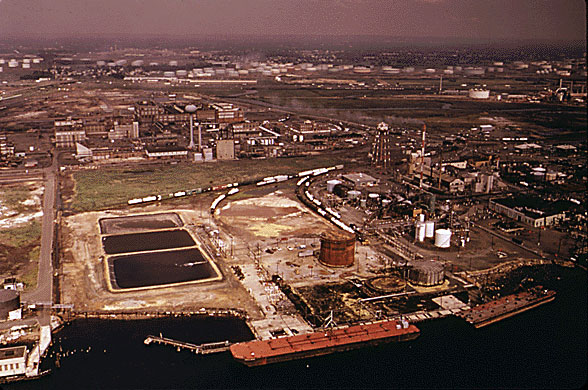
Aerial View (Looking Northwest) of DuPont and GAF Plants DuPont Plant In Foreground Along Arthur Kill GAF Plant Slightly West of DuPont Plant Photo:  EPA 1974

Aerial View (Looking Northwest) of DuPont and GAF Plants DuPont Plant In Foreground Along Arthur Kill GAF Plant Slightly West of DuPont Plant Photo: EPA 1974

The people of Linden gained a major victory last week in City Council’s rejection of a proposed redevelopment deal for the toxic Dupont site along the Arthur Kill. The deal called for construction of a $5 billion coal power plant known as “PurGen”.

Community activists and environmental groups formed a coalition – “Stop Purgen“-  that mobilized strong local opposition, which successfully pressured Council to kill the deal in a 7-4 vote last week. Linden is a heavily burdened environmental justice community (see this for successful EJ petition to DEP).

Labor groups pressed hard for the project for the jobs it would create.

With the defeat of the PurGen coal and dirty DuPont deal, the time is ripe for the environmental coalition to seize the initiative and propose a cleanup and redevelopment plan for the site that benefits the community, produces tax revenues, jobs, and reduces pollution.

Here it is:

1. Demand that DEP enforce State cleanup laws and force Dupont to cleanup the site.

The Dupont site and surrounding Tremley Point are highly contaminated and Dupont has dragged its feet for years on cleanup. If Dupont continues to drag its feet, DEP is authorized to conduct the cleanup themselves and recover “treble damages”, or 3 TIMES the costs of cleanup from Dupont. This is significant leverage to bring Dupont to the table and force a cleanup.

DEP recently took strong enforcement action against the City of Linden. DEP enforcement drove an Administrative Consent Order  (ACO) with the City to force closure and cleanup of the Linden landfill (see here). Dupont has not been subject to DEP  enforcement but deserves the same enforcement rigor that the City recevied. DEP should issue a Spill Act Directive to compel an enforceable  cleanup timetable, with stiff penalties levied against Dupont for failure to perform.

2. Leverage eminent domain powers to benefit the community, not developers

Local governments in NJ have not been reluctant to use eminent domain powers to take land for the benefit of developers. So, if DEP and/or Dupont are reluctant to proceed and cleanup the site, use eminent domain powers to acquire the site.

3. Finance the plan with “Natural Resource Damage” settlements.

In July 2005, DEP Commisioner Bradley Campbell cut a sweetheart deal with Dupont to settle hundreds of millions of dollars of “Natural Resource Damage” (NRD) claims at 8 Dupont facilities in NJ, including the Linden site. (see this for details). That deal was not only an unconscionable giveaway to Dupont, but the people of Linden received no economic benefits, dispite having suffered from Dupont’s toxic pollution for decades.

In June of 2007, Lisa Jackson’s DEP filed new NRD lawsuits against 120 polluters, including the old GAF site (now known as ISP) which is adjacent to the Dupont site, and the Bayway refinery (see this for list of 120 facilities and links to individual NRD lawsuit complaints). This time around, the people of Linden deserve the lion’s share of the NRD settlement proceeds. (Here is link to the GAF/ISP NRD lawsuit) (and here is a link to the Exxon Bayway NRD lawsuit)

Funding for cleanup and redevelopment would be provided from settlement of State “Natural Resource Damage” (NRD) lawsuits against Bayway refinery and ISP. Those suits could be settled rapidly for millions of dollars.

It is imperative that Linden receives a large portion of the NRD lawsuit settlements because:

a)    Brad Campbell’s DEP negotiated a 2005 sweetheart NRD settlement deal with Dupont for pennies on the dollar and Linden received none of the money;

b)   Linden Residents have suffered from the toxic pollution from Bayway and Dupont sites for decades

4. Form a municipal power authority and redevelop the site with solar panels.

The solar construction will produce good local jobs and ongoing energy revenues to reduce property taxes. Construction could be financed with a portion of the proceeds from the NRD lawsuits.

Categories: Uncategorized Tags:

It’s A Beautiful Day – Don’t Let It Slip Away

October 24th, 2009 Bill Wolfe No comments
Carteret Waterfront Park - kids enjoy a day of fishing

Carteret Waterfront Park - kids enjoy a day of fishing

Carteret man catched 36 inch striper in Arthur Kill

Carteret man caught a 36 inch striped bass in Arthur Kill

kids enjot excitement of a big fish

kids enjoy excitement of a big fish

Young women sing at Princeton chapel wedding today (It's a Beautiful Day - the inspiration for this post)

Young women sing at Princeton wedding today (It's a Beautiful Day - the inspiration for this post)

Categories: Uncategorized Tags:

DEP Denies Access To Former Corzine Aide Lobbying Records

October 23rd, 2009 Bill Wolfe No comments

In another in a series of efforts to mask political intervention and frustrate public oversight and accountability, yesterday DEP denied an Open Public Records Act (OPRA) request. This follows a recent OPRA lawsuit filed to force DEP to disclose similar records (see Star Ledger: N.J. environment group claims DEP denial of records request violated state law

Adam Zellner (R) former Corzine advisor and DEP Deputy Commissioner. Lisa Jackson (L)

Adam Zellner (R) former Corzine advisor and DEP Deputy Commissioner. Lisa Jackson (L)

The OPRA request sought public records on a meeting between DEP managers and Adam Zellner, a powerful political lobbyist, and former DEP Deputy Commissioner and policy advisor to Governor Jon Corzine (we initially wrote about the Zellner matter here).

The OPRA asked for documents related to an October 15 DEP meeting. Ordinarily, because of a serious lack of transparency at DEP, such a meeting would be secret, but a source gave me a tip. Here is the full text of the OPRA request:

Mr. Adam Zellner met with DEP officials on October 15, 2009 in the DEP HQ building. I request all records related to Mr. Zellner’s 10/15/09 meeting, as well as all prior correspondence and communications between DEP and Mr. Zellner from January 1, 2009 until the present.

DEP sign in book - 401 East State Street, Trenton

DEP sign in book - 401 East State Street, Trenton

DEP denied the request, despite the fact that the DEP building visitor’s log book requires that all visitors MUST sign in and identify who they are meeting with. Outrageously, one of the bases for the denial is that I didn’t have sufficient information on the meeting – which is the reason I filed the request in the first place! Here is DEP’s OPRA denial:

Since requester is unable to provide a NJDEP Contact Name, Program Area, or subject of meeting, this request has been denied on the basis that the request requires the NJDEP to conduct research & correlate data, which is not required pursuant to N.J.S.A. 47:1A-9 & Mag Entertainment v Div of Alcoholic Beverage Control 375 NJ Super 537 (App Div 3/05). In addition, this request has been denied based on the request being overly broad and unspecific to the records being sought pursuant to N.J.S.A.47:1A-5, N.J.S.A. 47:1A-9 & Gannett N.J. Partners v. Middlesex, 379 N.J. Super 205 (App. Div. July 2005).

(Does anyone recall scandals by former Governor’s aides involving political influence on government decisions?)

Zellner’s meeting with DEP illustrates several key reform issues:

1. Transparency and open government

DEP is a public regulatory agency, not a Las Vegas bawdyhouse. DEP must be transparent. Currently, DEP typically meets secretly for months in advance with polluters and developers on major projects. These “pre-application meetings” negotiate permit requirements and establish review schedules. At times, the formal public permit process is a sham, where DEP goes through the motions to issue a permit already decided. The public is put at a serious disadvantage by these meetings, and must be given equal information and access to DEP. See this for our transparency petition now pending before DEP Commissioner Mauriello).

2. Ethics – Revolving door restrictions

Zellner was DEP Deputy Commissioner until January 2008, when he went to Governor Corzine’s Office. Current ethics laws seek to prevent even the appearance that state officials gain economic advantage from their state service.  Current ethics law has post-employment restrictions (see here) . These requirements must be monitored, enforced and strengthened.

3. Whistleblower protections

DEP staffers witness ethically questionable or corrupt practices on a daily basis, but rightfully don’t want to sacrifice their careers disclosing wrongdoing. We need to empower the agency professionals and block the current widespread practice of retaliation for conscientious public disclosures of mismanagement, manipulation of science, and threats to public health and the environment. NJ’s current whistleblower laws do not protect employees who disclose such problems publicly. (see: Star Ledger: End Political Influence on DEP Regulators).

4. Integrity in Government decision-making

DEP decisions must be based on law and science, as well as fair and open to all parties. The process by which DEP makes decisions is critically important. In my experience, the integrity of decisionmaking at DEP has slipped badly in recent years. We must restore the public’s trust and confidence in DEP decisions. Such an effort must  include restrictions on what are legally known as “ex parte” communications to DEP. An ex parte communication is a communication to DEP from any person  about a pending DEP matter that occurs in the absence of other parties to the matter and without public notice and opportunity for all parties to participate in the communication. People often refer to these communications as “one-sided,” “off-the-record,” or private communications between a DEP staffer and any person concerning a matter that is pending or impending before the DEP. According to California regulations:

Rules regarding ex parte communications have their roots in constitutional principles of due process and fundamental fairness. With public agencies, ex parte communications rules also serve an important function in providing transparencyEx parte communications may contribute to public cynicism that decisions are based more on special access and influence than on the facts, the laws, and the exercise of discretion to promote the public interest.

Ex parte communications are fundamentally offensive in adjudicative proceedings because they involve an opportunity by one party to influence the decision maker outside the presence of opposing parties, thus violating due process requirements (See this for excellent California Guidance on prohibiting Ex Parte communications)

5.  DEP Independence from political interference

DEP is not a political arm of the Governor or legislature, it is a regulatory agency. A clear separation is required. Recently, the Governor’s office and powerful legislators have intervened and called the shots at DEP. One of the worst recent examples of this was the Encap debacle, a “scandalmongers dream”. DEP Commissioner Campbell overrode staff objections at the behest of Governor McGreevey.

On the financial side, state officials such as … DEP chief Bradley Campbell approved a $212 million state loan package to EnCap in 2005 even though regulators warned the loan was risky and was made without sufficient collateral.

Campbell, before signing off on the loan, called it “a scandal monger’s dream” in a note to McCormac. “Why in the world would we take the risk?” he wrote “What am I missing here?” Both officials have said their reservations were overruled by the governor’s office, which championed the project throughout the tenures of both McGreevey and Richard Codey. [link to Bergen Record story here]

This lack of independence at NJ DEP contrasts sharply with the policy set by William Ruckelshaus, the first EPA first Administrator under Richard Nixon. Please read this piece, for an excellent history and analysis of the issues involved:

Respecting EPA - Restraining presidential influence in EPA decisionmaking leads to better environmental and political outcomes

“… In its failure to show the same caution in its interventions with EPA, the Bush Administration has paid a price. While presumably maximizing the immediate political benefits of Agency decisions, it has depleted the Agency’s capital of legitimacy, with a resulting loss of credibility with other governmental institutions and the public. Congressional oversight hearings have multiplied, drawing unflattering scrutiny of Agency decisions, diverting Agency resources, and distracting

EPA leadership. As already mentioned, the courts have reversed an increasing percentage of EPA decisions, many on grounds that the Agency failed to follow the statute’s plain meaning. The Agency’s loss of credibility in the courts now looms as a factor in judicial reversal of cases that the Agency might otherwise have been expected to win. Criticisms of EPA decisionmaking have also spilled into the press and adversely affected the public’s views about whether the Administration is doing a good job with the environment. A September 2007 public opinion poll showed that only 20% approved of the president’s handling of environmental issues (compared to over 50% who disapproved), down from an environmental job approval rating of over 50% in the first year of the Bush Administration. While foregoing the ability to maximize political benefits over the short term, a more restrained exercise of presidential influence that maintains agency legitimacy and respects the Agency’s familiarity with the issues is likely to provide

greater political benefits over the long term and thus should be the preferred strategy of succeeding administrations, whether Democrat or Republican. This is exactly the conclusion

reached in 1983 by President Reagan, the president most identified with bringing the presidential control model into vogue, after the politically disastrous events surrounding the resignation of his first appointee as EPA Administrator, Anne Gorsuch. In announcing her replacement,   Ruckelshaus, President Reagan promised a new era of environmental protection and gave Ruckelshaus substantial discretion in managing the Agency–according to his principles. Let the new era begin.

The DEP Commissioner needs to stand up and restore DEP’s independence and integrity.

Categories: Uncategorized Tags:

Republicans Want to Eliminate DEP

October 20th, 2009 Bill Wolfe No comments
sunrise at Seaview

sunrise at Seaview

According to the Press of Atlantic City today, Republican challengers in the Assembly 1st District (Cape May/Cumberland/Atlantic) want to eliminate the DEP.

Let me repeat that – political candidates for the NJ Assembly want to eliminate DEP.


Cape May lighthouse - managed by DEP

Cape May lighthouse - managed by DEP

Republican candidates Mike Donohue and John McCann are on the outside looking in, and they do not like what they see. They say the DEP, with 2,978 employees and $327 million in state funding, is too big and responsible for too much. The agency covers everything from historic preservation to coastal management. It has numerous divisions, bureaus and offices, as well as 21 advising councils and commissions. 

The challengers want to eliminate the DEP and replace it with a smaller “Department of Natural Resource Management.”

I am one of DEP’s biggest critics, but this is ridiculous - I think we’ve crossed some kind of rhetorical threshold (and DEP does not get $327 million in state funding).

This kind of know nothing assault is what happens when the environment is taken off the public policy agenda during an election cycle.

This is not the mere radical craziness of a couple of South Jersey Republican challengers. These perverse views are shared by many uninformed politicians and voters.  

The Governor has failed to lead on the environment, and has a poor record. So Corzine has no incentive for even mentioning the environment during the campaign.  

Worse, Republican challenger Christie recklessly invites such crazy attacks by his call to slash DEP budgets further and transfer the natural resource programs out of the agency.

Independent Daggett, a candidate who knows better and has actual environmental management experience as USEPA Regional Administrator and DEP Commissioner, is not exactly out there leading the charge defending DEP.

The media is depleted by downsizing, diverted by the political circus, and seemingly locked into traditional horse race electoral coverage that ignores policy issues.

Environmental groups – heavily invested in Trenton lobbying –  seem to have lost all ability to organize and mobilize the public, or shape public opinion.

Let’s hope the voters can see through it, but that may be tough, because no one is talking about the environment, the protections DEP provides,or the economic facts.


DEP protects air quality

Beasley's Point - DEP protects air quality

If the typical voter is not concerned about DEP’s public health protections (clean air, clean water, drinking water, toxic site cleanup, oil and chemical plant safety, et al) and is concerned only about taxes and money, one fact they might want to consider is that ONLY 24.7% of DEP’s FY 2009 $230 million operating budget, just $56.81 million, is paid by taxpayers from the state general fund.


Under the “polluter pays” philosophy, over 75% of DEP’s budget comes from industry fees, pollution enforcement fines, and federal EPA grants. (read DEP budget here)

The total State budget for FY 2009 was $32.87 BILLION. That means that DEP’s share of the state budget was less than 2 tenths of 1% (0.17% – do the math).

There is NO money to be saved by cutting DEP.

Additional cuts to DEP’s budget can not be justified on fiscal grounds.

Actually, cuts would INCREASE taxpayer burdens because DEP would receive less federal grant funds and fee and fine revenues would be reduced as DEP workload decreases. These would have to be made up with general funds from the taxpayer. 

Taxpayers are getting a bargain at DEP!

It’s the polluters and developers who want DEP eliminated, not the voters. 

Shameful republican hacks are manipulating public opinion and doing the bidding of polluters and developers, who want DEP off their backs.


DEP protects our rivers, bays, estuaries

DEP protects our rivers, bays, estuaries

Categories: Uncategorized Tags:

Daggett is No White Hat on The Environment

October 19th, 2009 Bill Wolfe No comments

The business community’s news outlet NJBIZ, is running a story today on Chris Daggett’s environmental credentials. In the course of doing so, they predictably stress a business perspective and repeat certain myths about DEP and the economy. In our view, this puts Daggett in a negative light and provides an opportunity for me to rehash a critique of Daggett’s role as Chair of former DEP Commissioner Lisa Jackson’s controversial “Permit Efficiency Task Force”.  According to NJBIZ:

Chris Daggett, Independent candidate for Governor, drinks bottled water at NJ debate on energy & environmental issues

The need for speed in N.J. government

Daggett would use his experience in business and politics to succeed

Speed and efficiency.

These words aren’t often associated with New Jersey state government, but Chris Daggettsaid his time in the private sector has taught him they are traits the government needs.

[...]

Daggett points to his experience chairing a task force appointed by Gov. Jon S. Corzine to increase efficiency in the DEP permitting process. Task force member Joseph F. Riggs, group president of K. Hovnanian Homes, credited Daggett with forging consensus among the 24-member group for changes to DEP processes.

“There was give and take all the way around,” Riggs said.

The task force has its critics. Former DEP Commissioner Bill Wolfe said business interests were too dominant, and that it put speeding up development ahead of the environment.

“I think that it is a misguided effort,” Wolfe said, but credited Daggett with elevating the tone of the campaign.

I will be blunt: the DEP Permit Efficiency Task Force was a sham attempt to promote a business agenda, while disingenuously trying to mask its real anti-environmental agenda.

In this context, “faster” means a race to the bottom, or acceleration towards the edge of a cliff. “Need for speed” becomes “feed the greed”.

Perhaps I am being too blunt. The role of the DEP Task Force is aptly illustrated by this analogy, by Harvard professor Rory Stewart in a recent Bill Moyers PBS interview about the Obama administration’s deliberations on escalating the war in Afghanistan:
it’s as though they come to you and they say, “We’re planning to drive our car off a cliff. Do we wear a seatbelt or not?” And we say, “Don’t drive your car off the cliff.” And they say, “No, no, no. That decision’s already made. The question is should we wear our seatbelts?” And you say, “Why by all means wear a seatbelt.” And they say, “Okay, we consulted with policy expert, Rory Stewart,” et cetera. [Link to transcript]
As the history shows, the DEP Task Force grew out of one of the Corzine Administration’s failed attempts to promote economic development, particularly the housing and construction sectors.

Those failures were a direct result of Corzine’s flawed premise that environmental protection was a factor in the collapse of the housing market. But despite the repeated lies of construction industry lobbyists, we all now know that this collapse was a result of the collapse of financial markets, due in large measure to sub prime mortgages (see: “Builders Gone Wild“).

Regardless of the economic facts, the flawed thinking that blamed environmental protection and DEP “bureaucracy” resulted in passage of the Permit Extension Act, a series of DEP regulatory rollbacks, and the DEP Permit Efficiency Task Force.

DEP Commissioner Lisa JAckson (L) & DCA Commissioner Joe Doria (R)

DEP Commissioner Lisa JAckson (L) & DCA Commissioner Joe Doria (R)

Specifically, as folks will recall, Department of Community Affairs (DCA) Commissioner Joe Doria resigned in disgrace while under investigation in the “Operation Bid Rig” criminal probe. Prior to his resignation, Doria was the Administration’s public point of the spear in this flawed attack on DEP and environmental protections.
Behind the scenes, Corzine’s Economic Czar and Wall Street colleague Gary Rose, ran herd on DEP. Doria had formed his own stealth Task Force, stacked with developers and builders. The DEP Task Force was Lisa Jackson’s parallel initiative, intended to dampen the worst aspects of the Corzine, Doria, Rose agenda. 
So, with this brief history in mind, let’s excerpt and examine the policy Daggett presided over and takes ownership for as Chair of the Task Force:
1. Transparency, openess, and ethics,
Despite being petitioned to do so, Daggett did not support open deliberations, transparency and standards for ethical dealings applied to the Task Force he chaired. This record needs to be compared to his campaign rhetoric that stresses open government, transparency, and high ethical standards. Additionally, members of the Task Force were mainly political lobbyists, not scientists, engineers, or management and public policy experts. This reality conflcits with Daggett’s campaign rhetoric in support of science based public policy decisions in the public interest.
 
2. DEP mission and role
The Task Force recommended that DEP should “do less with less”:

 “In this time of fiscal crisis, the challenge, before the DEP is to develop different approaches to managing, to consider doing less with less, recognizing that this must be done without compromising environmental protection or public health.”

That add on about not “compromising” protections is pure spin – and it goes against the Daggettt campaign rhetoric about the need for hard choices.

In contrast to Daggett’s misplaced focus on speed and efficiency, at the same time the Task Force was deliberating, the US EPA audited DEP operations by focusing on quality, science, and whether DEP was achieving its mission. EPA reviews sought to INCREASE environmental performance, which is vastly different from expediting that performance to meet the business community’s needs and bottom line profit concerns.

3. Privatization and deregulation

The Taskforce recommended that privatization and deregulation should be expanded 

“In an output/performance-driven system, the DEP would focus on the efficient execution of inherently governmental functions and explore using outside assistance, advanced IT tools or both, to complete the straightforward tasks that are not necessary to be done by government. To accomplish this, a major change must occur in the way that scope and responsibility are allocated within the DEP. In short, if the DEP is ever going to reach a high level of efficiency and effectiveness, the goal for the DEP should be to determine which environmental services are essential and which can be eliminated; which can be consolidated and which cannot; which must be provided by government and which can be delivered by outside vendors or through advanced IT tools, or both.”

4. Honest politics and government

Based on a review of the Corzine administration’s actions, it becomes clear that the policy motivation and agenda for the Task Force were concealed. Daggett went along with this game.

The original composition of Task Force was established in Jackson’s Administrative Order. But the original composition was expanded to include environmental, community and public interest representatives only AFTER strong public criticism of its failure to represent public interests (see this criticism which drove that expansion). I personally spoke to Daggett about this, because he publicly stated that the Task Force was his idea and evidence that he could work with diverse constituents.  Well, if so, then why didn’t the original include those diverse interests? Why didn’t Daggett fix this?

The members of the Task Force included representatives of residential and commercial developers, environmental organizations, land use planning firms, nongovernment organizations, housing advocacy groups, business and industry, the environmental justice community, counties, municipalities, public utilities authorities, engineering firms, the EPA, the Governor’s office and environmental consulting firms. Three were former cabinet members: DEP, Transportation and Community Affairs. 

This composition shows that the initiative was primarily political, not science and policy oriented. This is not exactly the independent good government model Daggett talks about on the campaign trail.

5. The pro-environment objectives were used as green cover

The Order creating the Task Force included pro-environmental policy objectives (in bold):

b. The report of the Task Force shall also provide recommendations for operational, policy and regulatory changes at the department to provide incentives for and to advance sustainable development projects that contribute to achieving statewide greenhouse gas limits, economic growth opportunities in urban areas and meaningful affordable housing and that, as a result of their location and design, have little or no impact on public health and safety, the environment or natural resources; and

c. As part of its deliberations, the Task Force may also identify possible statutory changes that would result in enhancing the DEP’s timely and efficient service or the DEP’s ability to provide incentives for sustainable development projects that contribute to achieving statewide greenhouse gas limits, economic growth opportunities in urban areas and meaningful affordable housing and that, as a result of their location and design, have little or no impact on public health and safety, the environment or natural resources.”

But the pro-environmental policy objectives were completely ignored in the Task Force Report. This fact seriously calls into question Daggett’s rhetorical commitments to balanced policy.

6.  Orwellian euphemism was used to mask a pro-business anti-environmental agenda:

“In short, the Commissioner formed the Task Force out of a concern that the current permitting process cannot keep up with demand. The Commissioner asked the Task Force to help her in making the permit process more timely, predictable, consistent and transparent to the regulated community [Note: but what about to the public?] and to do so at the lowest possible cost to taxpayers while enhancing New Jersey’s environment.” 

That finding is long on euphemisms and short on substance - and it conflicts with Daggett’s claims of the need for tradeoffs, compromises, and tough choices.

7. Faster means weaker protections – DEP already rubber stamps 90-95% of permits – only the really bad projects need “streamlining”

The Report found DEP approves the overwhelming majority of permits within deadlines, and that only really bad permits must be expedited – this shows the real agenda of the Task Force - to promote bad projects and expedite their permits: 

“Overall, 90 percent to 95 percent are approved, often with substantial changes as a result of DEP input, with the remainder being denied or withdrawn. The permit decisions are usually made within the statutory timeframe, which varies from program to program. The permitting system breaks down most frequently when there are multiple permits for a single project, when projects are large in size and when impacts to the environment are complex and potentially extensive.”

8. The Private sector knows best -

The Report recommended that DEP should emulate the lprivate sector – the same folks who caused the economic collapse, and just so happen to be large polluters who have off-shored jobs and deindustrialized the US manufacturing base. This private sector uber alles mentality also ignores the fundamental legal and policy reality that DEP protects public resources that are not subject to market values, but to democratic preferences and science:

“Overall, there is no single silver bullet that can fix the various permitting problems of the DEP. Rather, what is needed is similar to the approach that enables certain manufacturing companies to stand out in their fields. The success of these companies is rooted in rigorous and unrelenting attention to all of the little details of the manufacturing process, or in the DEP’s case, the permitting process. The successful manufacturing companies have created a work culture with a bias toward action – a performance-driven environment – and have empowered its employees to perform.”

9. A rationale Commissioner Jackson relied on to privatize DEP science (i.e. Science Advisory Board) and abolish the Division of Science and Research

Although it is clearly limited to academic scientists, this recommendation was misused by Commissioner Lisa Jackson to abolish DEP DSR and seek greater private sector control via a new SAB:

 “In the course of Task Force deliberations, two issues arose which were outside the charge of the Administrative Order but which directly impact the efficiency of the DEP. The first is the quality of science and research that provides the underpinning of the policies, guidance, directives and regulations of the DEP. Through the first two decades of the DEP’s history, the Office of Science and Research was one of the most highly regarded programs in the country. However, during the past two decades, budget cuts and reorganizations have undercut the quality of the program. While the Office still does excellent work, the staff simply cannot keep up with the breadth and scope of DEP needs. Accordingly, the TaskForce recommends that the DEP convene a study group that examines this issue and addresses possible ways to restore the stature of the Office, with a particular focus on collaborative efforts with academic research institutions and outstanding practitioners to minimize or avoid significant budget and staff increases.”

Also, the recommended public “study group” was never formed, nor was the mistaken recommendation to “restore the stature of the Office” implemented. The recommendation also is based on an error: DEP Science and Research was a Division at the time of this Report, not an office. - this is a revealing error. The Division was downsized to an Office based in part on this recommendation.

[correction: I was a former DEP policy analyst, not DEP Commissioner. NJBIZ got it wrong on that]

Categories: Uncategorized Tags: