Archive

Archive for March, 2011

A is for Atom

March 29th, 2011 1 comment
Salem nuke plant (NJ)

Salem nuke plant (NJ)

Given the 32nd Anniversary of the Three Mile Island partial nuke meltdown and the ongoing  crisis in Japan, I thought it would be a good time to repost a link to a superb BBC documentary on the history of civilian nuclear power.

Please watch this BBC documentary by Adam Curtis “A is for Atom“.

It begins with the quasi-religious utopian origin of the nuclear technology and virtual public worship for scientists that spawned the phrase “nuclear priesthood“.

This is the period I was born and educated in, and it still resonates. I can still recall my disillusion with science, which really didn’t begin until college, as I learned of the social and environmental consequences of science and technology abused under a corporate capitalist system.

The documentary shows how the heroic postwar scientists and technologists were quickly co-opted by the politicians and dominated by corporate interests, particularly at GE and Westinghouse.

As politicians and industry PR oversold the utopian benefits of the nuclear power genie (the way to a better world – electric power too cheap to meter – on the threshold of a new age – even your toothpaste may be a product of the atomic age), the regulators were boxed in and lacked the effective power to control the nuclear industry.

Scientists, regulators, and politicians could not admit mistakes they made, because so much had been committed to nuclear power technology:

“after having told the public that the nuclear technology was safe, we just couldn’t admit that we were wrong’ according to one scientist.

There are incredible interviews with scientists and regulators, in US, Britain, and Russia.

One famous US scientist, an early champion of nuclear power, in retrospect frames the issue thusly:

“I think the basic question is: can modern intrusive technology and liberal democracy coexist?”

Interviews with scientists and regulators disclose how the nuclear industry deliberately concealed true risks, and cut corners on safety. Government regulators admit that they were pressured to cut costs and expedite approvals of construction of excessively scaled up, dangerous designs and technology.

This is a must see documentary. 

Is is part of Curtis’ superb BBC multi-part series on the history on modern science called “Pandora’s Box”.  Click on and Watch them all when you get a chance. 

Categories: Uncategorized Tags:

A Vast Right Wing Conspiracy

March 28th, 2011 2 comments

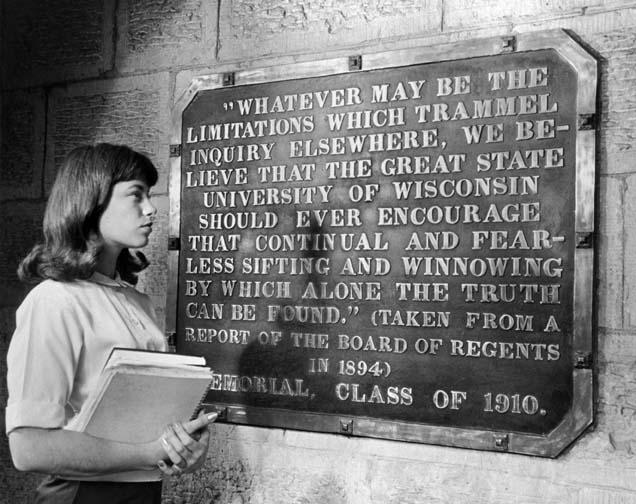
wisconsin

[Update below]

I sensed for more than a year that a coordinated right wing agenda was driving events in State Capitols – and suspected that NJ Governor Chris Christie was a leader in this effort (see this March 26, 2010 post:  Christie’s Environmental Rollbacks Receiving National Attention)

For example, long before the Wisconsin protests, I noticed that shortly after Christie cancelled the ARC tunnel project, similar public transit projects were killed in Ohio and Wisconsin, Republican places where Christie had campaigned.

My suspicions were heightened when our neighboring Pennsylvania Republican Gubernatorial candidate advocated a regulatory policy platform very similar to Governor Christie’s.

Then after the fall 2010 election, Maine and Florida Governors both announced anti-environmental “Red Tape” regulatory rollback initiatives. Press coverage in Maine stated that it was modelled on Christie NJ efforts.

Well, it is all much clearer now, thanks to the research of  University of Wisconsin history professor Bill Cronon - there really is a vast right wing conspiracy.

Cronon writes about his own similar thoughts:

After watching the sudden and impressively well-organized wave of legislation being introduced into state legislatures that all seem to be pursuing parallel goals only tangentially related to current fiscal challenges–ending collective bargaining rights for public employees, requiring photo IDs at the ballot box, rolling back environmental protections, privileging property rights over civil rights, and so on–I’ve found myself wondering where all of this legislation is coming from.

Cronon traces that coordinated legislative effort to a right wing group called the American Legislative Exchange Council (ALEC):

Telling Your State Legislators What to Do:
The American Legislative Exchange Council (ALEC)

The most important group, I’m pretty sure, is the American Legislative Exchange Council (ALEC), which was founded in 1973 by Henry Hyde, Lou Barnett, and (surprise, surprise) Paul Weyrich. Its goal for the past forty years has been to draft “model bills” that conservative legislators can introduce in the 50 states. Its website claims that in each legislative cycle, its members introduce 1000 pieces of legislation based on its work, and claims that roughly 18% of these bills are enacted into law. (Among them was the controversial 2010 anti-immigrant law in Arizona.)

If you’re as impressed by these numbers as I am, I’m hoping you’ll agree with me that it may be time to start paying more attention to ALEC and the bills its seeks to promote.
You can start by studying ALEC’s own website. Begin with its home page at
http://www.alec.org

Cronon writes about environmental history and I am pleased to note that he recognizes that attacks on the environment are a primary target and ideological obsession of these right wingers.

There are reasons for that. It is because environmental protection involves a strong role for government intervention in so called “free markets” and regulation of powerful corporations - both concepts that are ideologically taboo in right wing circles.

I’ve been writing about and trying to get these points across for years - ideology is very frequently the determining factor in environmental policy disputes.

Cronon writes:

Interestingly, one of the most critical accounts of ALEC’s activities was issued by Defenders of Wildlife and the Natural Resources Defense Council in a 2002 report entitled Corporate America’s Trojan Horse in the States. Although NRDC and Defenders may seem like odd organizations to issue such a report, some of ALEC’s most concentrated efforts have been directed at rolling back environmental protections, so their authorship of the report isn’t so surprising. The report and its associated press release are here:
http://alecwatch.org/11223344.pdf
http://www.nrdc.org/media/pressreleases/020228.asp

For doing this research, creating his own superb blog (Scholar as Citizen), publishing a hard hitting Op-Ed in the NY Times (Wisconsin’s Radical Break) and taking on this fight, Cronon has come under attack.

A Wisconsin Republican legislator has filed a McCarthyite public records request for his emails – which the NY Times editorial page blasted today (see “A Shabby Crusade in Wisconsin“.

The Republicans over-reach in Wisconsin – home of “have you no shame” Senator McCarthy - is really showing the ugly and ideologically extreme agenda that has captured the party.

Lets hope Americans finally wake up and fight back, so that the Wisconsin battle turns out to be their Waterloo.

[Update 1: while the NY Times editorial page and much of the country are correctly outraged that a McCarthyite public records request was filed by Republicans tointimidate and silence a university of Wisconsin professor, I must note that we reported and condemned very similar abusive tactics here in NJ.

Specifically, Dupont filed a NJ Open Public Records Act (OPRA) request that targeted DEP scientist. We wrote in “Dupont: Doubt (and intimidation) Are Their Product“:

In a hostile move, lawyers representing DuPont filed several  OPRA requests that personally targeted and intimidated the DEP scientists conducting the PFOA research.

Scientists should enjoy the same intellectual freedom as scholars – free from both abuse of state and corporate power. As the good Wisconsin professor eloquently wrote:

It is precisely this fear of intellectual inquiry being stifled by the abuse of state power that has long led scholars and scientists to cherish the phrase “academic freedom” as passionately as most Americans cherish such phrases as “free speech” and “the First Amendment.”


Categories: Uncategorized Tags:

Christie Bowing To Koch Brothers on RGGI

March 28th, 2011 4 comments

Governor Christie is getting national press attention for recent controversial remarks in Nutley, suggesting that he was considering unilaterally pulling NJ out of the northeast states’ Regional Greenhouse Gas Initiative (RGGI).

The RGGI was negotiated by former Governor Corzine’s DEP Commissioner Lisa Jackson, who is now Obama’s US EPA Administrator.

But RGGI was enacted by the legislature, an authorization that makes the program a key electric sector component to meeting the emission reduction goals of NJ’s Global Warming Response Act legislation.

So, Christie again is catering to right wing conservatives, subsidizing major polluters and setting up a battle with the legislature.

According to E&E News, a subscription beltway trade journal (no link available):

Christie suggests he might take N.J. out of regional greenhouse gas control program (3/28/11)

Christa Marshall, E&E reporter

New Jersey‘s governor is floating the idea that he might take his state might out of the upper East Coast’s greenhouse gas regulatory program, raising questions about the future of the nation’s only operating cap-and-trade system.

The comments from Republican Gov. Chris Christie also prompted further speculation about the governor’s presidential ambitions and whether he is catering to national voters’ suspicions of emissions caps.

At a town hall last week in Nutley, N.J., Christie expressed concern that the Regional Greenhouse Gas Initiative, or RGGI, is putting his state at a disadvantage because neighboring Pennsylvania is not a participant. He said he would decide within two months about the state’s role in the program, which has been capping carbon dioxide emissions of utilities in 10 Northeastern and mid-Atlantic states since 2008.

“Is there enough of a benefit to the state to keep it going, or is it too much of a detriment on business? And the thing I’m most concerned about is that it doesn’t seem to be working in the entire region. The value of these credits are getting less and less as we continue to go further and further out, and so the value of the program is becoming less and less,” Christie said in response to a question from the audience.

“And in addition, I’m concerned about the burden that it places on our businesses, making them less competitive with Pennsylvania, because our businesses have greater costs involved than in Pennsylvania. So we are evaluating all that, and within the next two months, I’ll give you a definitive answer on whether we are going to continue it,” he said.

The re-evaluation of RGGI would come as part of a new energy master plan for the state that Christie said he would release in the “next couple of months.”

Of particular significance is that RGGI has been targeted by the billion dollar right wing Koch brothers, an oil and chemical industry giant. The Koch’s are the money behind the TeaParty and the failed attack on California’s global warming legislation known as AB32. NJ’s Global Warming Response Act was modelled on California’s AB32.

Koch group mounts anti-RGGI campaign

The group Americans for Prosperity, which has been running advertisements against RGGI, has an active presence in the state via Internet postings and state meetings. The state director of the group, Steve Lonegan, slammed the “RGGI scheme” at a local event last week, partially because of what he called “speculators” playing the carbon market, according to NorthJersey.com. Americans for Prosperity was co-founded by oil billionaire David Koch.

It is not clear whether New Jersey law allows Christie to unilaterally leave the initiative, said one legal expert. “If he were to try it, there would most certainly be a legal challenge,” said the expert.

According to official RGGI documents, the other participating states in the Northeast and mid-Atlantic would “appropriately adjust” allowances bought and sold in the trading market to account for the withdrawal of one state.

In the case of a New Jersey departure, the issue would be more political than technical, at least initially, said Stacy VanDeveer, an associate professor of political science at the University of New Hampshire.

The program’s cap on emissions is too small at this point for any New Jersey action to matter much in terms of how the trading platform operates, he said. Instead, the action of state representatives during an upcoming regional review of the initiative is more important, he said. New Jersey’s sheer size — and percentage of emission allowances — means its viewpoint could sway the outcome of things under consideration, such as whether the cap is strengthened, he said.

It also takes “momentum away” from the program at a time when climate legislation is defunct on Capitol Hill, he said. The initiative is also facing a challenge in New Hampshire, where Republicans have moved a bill through one chamber of the Legislature to exit the regional plan.

And once again, the Christie Administration’s signals are crossed.

It looks like DEP is doing another Schundler, by making press statements directly at odds with the Governor’s statements. Or perhaps DEP is providing cover for the Governor:

Spokespeople in the governor’s office and the New Jersey Department of Environmental Protection denied there was any movement to leave the program.

“At the moment, we’re not going anywhere,” said Lawrence Ragonese, a spokesman for the Department. A Christie official said it would be crossing a “bridge we not have come to” to speculate about how the state procedurally would leave the greenhouse gas initiative.

At the moment, I think they’re full of crap.

Categories: Uncategorized Tags:

Barnegat Bay TMDL Update

March 27th, 2011 No comments

In light of recent events (see below COA letter), I thought it timely to provide an update on the Barnegay Bay TMDL bill, conditionally vetoed by Governor Christie on February 3, 2011.

As we previously wrote, we look to EPA to enforce Clean Water Act Section 303(d) TMDL requirements that currently apply to Barnegat Bay, and to hold NJ DEP to the TMDL commitments made in a 2002 EPA/DEP Memorandum of Agreement.

There are 2 very specific and transparent regulatory steps for EPA to take to enforce this commitment. EPA has adequate legal and funding leverage over DEP to make both happen, and has used this leverage previously plenty of times, e.g. a threat to withold EPA funds and federally implement the TMDL program in NJ is what led to the 2002 MOA. I was in the room representing DEP Commisioner Campbell when the threat was made in 2002 by Kevin Bricke of EPA Region II.

First, EPA must demand that the entire Barnegat Bay be included by NJ DEP on the 2010 impaired waters list, as impaired for failing to comply with nutrient policies in the NJ SWQS and failure to attain designated use of aquatic life support, fisheries, and direct contact recreation. There are multiple lines of existing scientific evidence and scientifically robust water quality and ecological indicators that support this impairment determination (see eutrophic condition indicators in Rutgers Professor Kennish powerpoint). 

DEP could support an impairment determination under the same ”weight of evidence approach” that DEP uses to support other site specific regulatory determinations (such as the Category One Waters designation, which is based upon an integrated ecological assessment). DEP lawyers have advised that this methodology – and similar site specific applications of scientific judgement - do not require public notice and rulemaking adoption. Similarly, the current aquatic life criteria use support assessment methodology used to determine designated use attainment relies on best professional judgement in interpreting the macro-invertebrate sampling data and assessment methodology. 

DEP public noticed a draft 303(d) impaired waters list in November 2010 and is scheduled to submit the 2010 303(d) list to EPA for review and approval this spring.

Second, EPA must demand that NJ DEP include the Barnegat Bay on the DEP’s 2010 2 year TMDL priority list. This priority list was published for public comment in November 2010 and will be submitted to EPA for review and approval this spring.   

If EPA and DEP deliver on these two steps, there is no need for any NJ State legislation.

Last, we noted that at the state level, the ball now is in the Legislature’s court.

We urge the Legislature to either let the bill die or over-ride the Governor’s veto language. Since over-ride majorities are unlikely, the best path is to let the bill die and informally urge EPA to act.

We went into great detail laying out our reasons why the Governor’s CV is an unacceptable step backwards.

Basically,  among other things, the CV language does not mandate that a TMDL be conducted by DEP. The CV would allow DEP to avoid tough regulatory decisions because it would allow DEP to delay – perhaps indefnitely - making a formal “impairment” determination, i.e. specifically included in the CV language are new legal factors DEP must consider including: 1) lack of adequate science; 2) lack of adequate data; 3) lack of a numeric standard for nitrogen; 4) economic considerations; 5) or exercise of State discretion under the Clean Water Act .

An impairment finding is a pre-requisite to a TMDL, so regardless of the 3 or 5 year period for a TMDL, if there is no impairment finding by DEP there can be no TMDL and obviously no TMDL implementation. 

We were disappointed – but not surprised – to learn that COA is pushing to have NJ environmental groups sign on to a letter to the Legislature is support of the Governor’s CV (see below). We urge those groups not to do so and are willing to engage in discussion as to why.

But it is obvious that we have more than a failure to communicate here, as there are glaring flaws in COA’s analysis of the CV and their very selective excerpts of same.

First off, COA fails to note that DEP has long opposed a TMDL on the Bay and that, most recently, DEP testified AGAINST a TMDL when the bill was up before the Senate Environment Committee (I was there to testify at that hearing, COA did not).

Second, the COA letter naively quotes a key sentence from the Governor’s CV totally out of context. 

In the CV language COA quotes and praises, the Governor – consistent with his “common sense” regulatory policies in Executive Orders 1-4 and the Red Tape Commission - was disparaging the regulatory mandates and enforcement aspects of a TMDL, especially federal oversight and control by US EPA and the adverse economic cost impacts on property owners and local governments.

That’s why the Governor’s 10 point Barnegat Bay plan is based on voluntary local partnership and incentives, and why it lacks any regulatory teeth and enforcement tools (the Plan even says it will “determine if a TMDL is feasible” – and retains the lead of the non-regulatory Barnegat Bay Partnership).

And of course, given the strong political opposition by the Ocean County Freeholders, the Governor is not going to undercut his Republican colleagues.

Is COA on the same planet? Are they that naive? Or incompetent? Or just providing cover for the Governor?

And last, COA simply fails to understand the CV language that impacts the DEP impairment determination.

If the Governor and DEP were seriously committed to a TMDL, they would take the first two steps outlined above to get the TMD process underway. 


● Clean Ocean Action  ● Pinelands Preservation Alliance ●

New Jersey Senate Leadership

New Jersey Assembly Leadership

Cc: The Honorable Chris Christie

March 28, 2011

To whom it may concern;

We write to you today to express our support for Assembly Bill 3415, the “TMDL Bill,” which was conditionally vetoed by Governor Christie on February 3rd, 2011. Please inform your colleagues that our groups support the bill as amended by the Governor and urge them to act swiftly to approve the changes. The bill, if made law, provides a tool to ensure that cuts to pollution harming the bay are comprehensive and strong – even with the Governor’s amendments.  A TMDL, to quote the Governor’s conditional veto, “is ultimately an enforcement tool under both state and federal law that compels parties to implement measures to reduce the amounts of pollutants they discharge.”

Although the Governor’s changes may slow down the timeline for adoption of the TMDL, changed language adds an additionally enforceable mandate that we find beneficial for the Bay –  that the TMDL must be adopted and implemented within the timeframe of 5 years. Also, nothing in the amended bill would preclude the DEP from implementing the TMDL before the 5-year deadline. The environmental community plans on helping to develop the state of science and policy in the Bay to see that this process is as quick and thorough as possible.

Encouragingly, the Governor’s changes keep the provisions of the original bill that expand the DEP’s use of science and they leave unchanged the section of the original bill that requires the DEP to use all its existing authorities to “to the maximum extent practicable to reduce sediments and nutrients during the study and the development of the total maximum daily loads.” To that end, our groups look forward to meeting and discussing with you additional approaches to stemming the tide of pollution flowing into the Bay.

In closing, we want to thank you for your leadership to protect New Jersey’s natural pearls – the Jersey Shore and Barnegat Bay – and recommend that the Governor’s conditional veto be accepted by both Houses of the New Jersey Legislature.

Sincerely,

Cindy Zipf

Executive Director, Clean Ocean Action

Jacylyn Rhoads, Director for Conservation Policy, Pinelands Preservation Alliance

Categories: Uncategorized Tags:

Turnpike Authority Illegally Clearcuts 30 Miles of Trees and Lies About It – Where’s Christie?

March 27th, 2011 1 comment

DEP Defends Lies and Violations of Reforestry Requirements

[Update 3: 4/10/11 -  The AC Press is staying on this story, today's coverage: Mayors say parkway tree cutting hurts towns through noise, erosion, decreased property values

I almost spewed my coffee when I read this quote from those tree loving realtors:

Drew Fishman, an agent with ReMax Atlantic and a former president of the New Jersey Association of Realtors, said there is no question that the tree removal will affect property values.

“When people are looking at a home close to the road, they look for a buffer, and that buffer can absolutely impact home value,” Fishman said. “Just how much of an effect the loss of that buffer will have is also dependent on other factors like the value of the neighborhood. It can also lead to a lot of people wanting to leave an area, which also affects total value in a neighborhood.”

And the Turnpike Authority surely must know that tree removal dramatically increases runoff, which makes this a big fat lie:

Turnpike Authority spokesman Tom Feeney said any conversation about property values has to take into account the “economic and safety benefits the shore counties will enjoy as a result of the work.”

Feeney said the agency believes any concerns about runoff are unfounded because the tree stumps and underbrush that remain will prevent it. Other concerns about aesthetics must be balanced against the need for the project, he said.

Update 2: 3/30/11 - scathing AC Press editorial: "So Now We Know"

This $6 million tree-cutting project is a debacle. The parkway is aesthetically marred. What was lovely greenery is now a virtual moonscape. Meanwhile, the natural sound barrier between nearby homes and the highway is gone. And so are the positive environmental effects of trees, including flood prevention and wildlife habitat.

But I'm not sure we really do know. The Turnpike Authority is quoted that DEP knew for years about the project and that there was extensive correspondence:

“There are letters between the Turnpike Authority and the DEP going back several years in which the Turnpike Authority describes the tree removal on the Parkway as part of the widening project.

How could DEP let this happen? That's what I want to know.

Update 1: 3/30/11 - As a result of the great work of the AC Press, Senator Van Drew jumps inot the fray - good for him: State Sen. Jeff Van Drew wants parkway operator to explain discrepancy in reasons given for tree clearing

But when reached by phone on Tuesday, Van Drew said that more of an explanation is needed.

“I have been dealing with this situation for a while, before the article came out, and I was told in great detail by the head engineer that this was something being done solely to protect drivers. And I could understand if it was just a matter of cutting a few trees and branches back, but this looks like a logging operation. … If you were to fly overhead, it looks like we were strip mining,” said Van Drew, adding the clear cutting of entire sections of median now could actually put drivers at risk of head-on collisions. “And what if the money never becomes available for the widening? What was this all for? I think they’re spending tax dollars to do this clearing and make the Parkway less desirable.

“We need a clear and thorough explanation of why this project was repeatedly misrepresented and then we need to make it right, or at least make sure it doesn’t happen again.” (end update)]

If a slimy Teabagger surreptitiously video-taped a public Authority worker lying about his lunch hour or using a state vehicle for personal reasons, we all know the drill:

  • the right wing Magic Wurlizter Echo chamber would spring into action
  • Governor Christie would do his Town Hall YouTube attack dog routine, bemoaning lazy workers, greedy unions, and unaccountable public Authorities
  • Democrats and liberals would cower in fear and sit back in silence, or join the mob (Worse, some craven weaklings may act pre-emptively upon the first indication of potential attack under a “damage control” mentality) 
  • a good public servant would be forced to resign, have career destroyed, and/or be smeared

So, what happens when real journalists at the Atlantic City Press document massive environmental abuse, serious violations of DEP regulations, and blatent lies by NJ Turnpike Authority managers?

Where is our Governor? Crickets.

Where is DEP enforcement? AWOL.

Can you imagine the DEP enforcement response if a small home builder cut down hundreds of acres of trees at the edge of wetlands and the environmentally sensitive Pinelands, failed to obtain DEP approvals, and was caught knowingly lying about it to DEP? 

Yesterday’s superb Atlantic City Press story Tree clearing along Garden State Parkway is also part of highway widening efforts, records show tells exactly that story.

The AC Press documents massive environmental abuse, unaccountable arrogance, violations of DEP requirements, and lies.

After publicly claiming that the massive tree-clearing along 34 miles of the Garden State Parkway has nothing to do with that roadway’s $900 million widening project, the New Jersey Turnpike Authority has admitted the projects go hand in hand but that it still hopes to avoid replacing the felled trees.

The contract for the tree-clearing project, obtained by The Press of Atlantic City through the Open Public Records Act, describes the work as “advanced clearing for the Garden State Parkway Widening Milepost 30 to 64.5” and is referred to as such throughout the document.

Veronique Hakim, executive director of the Turnpike Authority, which maintains the 172-mile toll road, confirmed that the tree-clearing is being done in advance of a third lane being added in both directions between Atlantic and Ocean counties, a prime growth area. Hakim said the Turnpike Authority does not have enough funds to proceed with the next phase of the road project but that the tree-clearing is being done to enable the project to move forward once the funds are available. 

The state’s No Net Loss Reforestation Act requires a tree be replanted for every one felled during a construction project that is more than a half-acre in size, such as the Parkway widening. As an alternative to planting a tree, a builder also may put money in a fund devoted to buying and planting trees. ….

In recent months, the Turnpike Authority has repeatedly said the clearing is not part of the $900 million parkway widening project that, when completed, will widen the roadway between mileposts 80 in Toms River and 30 in Somers Point, but rather a maintenance program designed to keep drivers safe and the roadway clear of debris. …

A tree for a tree

Environmentalists are accusing the Turnpike Authority of attempting to circumvent the reforestation act to save money.

Jeff Tittel, director of the New Jersey chapter of the Sierra Club, said he believes the parkway’s operators are trying to avoid the state’s requirement that trees felled for construction projects be replaced on a one-for-one basis. Tittel and other environmentalists say the authority is playing word games with the tree-cutting project by calling parts of it “routine maintenance” and other parts “firebreaks.” If the tree-cutting is classified as something other than a widening project, the authority could legally avoid replacing trees or could be forced to pay less for the trees removed.

“This is not a maintenance project to remove a couple of dead trees,” Tittel said. “This is a clear-cutting of a 30-mile stretch of the parkway.”

So, what is DEP’s response? Do they highlight the ecological significance, condemn the violation, and issue swift and stiff multi-million dollar fines?

Nope, they defend the Turnpike Authority, as a “sister agency” – despite the fact that “it still hopes to avoid replacing the felled trees.” 

That’s right – at the highest levels, DEP Deputy Commissioner Kropp – someone known to practice the black bureacratic arts of spin and lies herself - sympathizes with her “sister agency“.

Illustrating the same lack of management diligence and lax regulatory oversight she exercised that led to the demise of the DEP Site Remediation Program, Kropp looked the other way and made excuses:

The authority has submitted a plan to the state Department of Environmental Protection to mitigate the loss of wetlands and trees, although it did so only after the clearing work had begun, a breach of etiquette if not of the regulatory process.

“Admittedly, this is kind of putting the cart in front of the horse. The (tree removal) probably shouldn’t have started until a plan was in place. But we will hold them to the exact same standards as we would have if the plan was in place since day one,” DEP Deputy Commissioner Irene Kropp said….

On March 17, Kropp told The Press that the Turnpike Authority submitted a reforestation or payment plan in February for the section of the project that stretches between mileposts 30 and 64.5, but that the plan still had not been reviewed at that time.

Kropp said she did not think a sister agency, such as the Turnpike Authority, would attempt to circumvent its responsibilities. But she said the no-net-loss requirements can be unclear, which could be why there is so much debate over the Turnpike Authority’s obligation.

Apologetics for massive environmental assaults is the New Normal at the Christie DEP. 

And in the “What was he thinking” warped views category, NJ Audubon actually supports the Turnpike Authority clearcut:

Pete Dunne, chief communications officer for the New Jersey Audubon Society, said there are some positives that could come from the clearing.

“This is probably a give-and-take for the environment,” Dunne said. “Millions of birds are killed by automobiles every year. … Trimming the vegetation back from along the highway will probably reduce the number of bird strikes.”

Right.

When so called environmentalists defend highway clearcuts and violations of DEP wetlands and reforestry requirements,  yes, we have lost our way.
Categories: Uncategorized Tags:

We’ve Lost Our Way

March 26th, 2011 No comments

A nation that continues year after year to spend more money on military defense than on programs of social uplift is approaching spiritual death.

Martin Luther King, Jr. “Beyond Vietnam – A Time To Break Silence

Below is the kind of superb social and economic justice writing the NY Times should have been doing for the last 30 years, ever since deindustrialization, free trade, and “the Reagan revolution” - and the predictable devastation of our communities and our schools. 

Unfortunately it’s NY Times columnist Bob Herbert’s last column - reprinted in toto without permission. So sue me for infringement of intellectual property rights NY Times! (I doubt Bob Herbert would mind – or maybe I could claim that the Times stole my May 26, 2008 headline of  this Star Ledger piece: We have lost our way -  “corporate makeover of politics struggling to be democratic”


Losing Our Way

By BOB HERBERT

So here we are pouring shiploads of cash into yet another war, this time in Libya, while simultaneously demolishing school budgets, closing libraries, laying off teachers and police officers, and generally letting the bottom fall out of the quality of life here at home.

Welcome to America in the second decade of the 21st century. An army of long-term unemployed workers is spread across the land, the human fallout from the Great Recession and long years of misguided economic policies. Optimism is in short supply. The few jobs now being created too often pay a pittance, not nearly enough to pry open the doors to a middle-class standard of living.

Arthur Miller, echoing the poet Archibald MacLeish, liked to say that the essence of America was its promises. That was a long time ago. Limitless greed, unrestrained corporate power and a ferocious addiction to foreign oil have led us to an era of perpetual war and economic decline. Young people today are staring at a future in which they will be less well off than their elders, a reversal of fortune that should send a shudder through everyone.

The U.S. has not just misplaced its priorities. When the most powerful country ever to inhabit the earth finds it so easy to plunge into the horror of warfare but almost impossible to find adequate work for its people or to properly educate its young, it has lost its way entirely.

Nearly 14 million Americans are jobless and the outlook for many of them is grim. Since there is just one job available for every five individuals looking for work, four of the five are out of luck. Instead of a land of opportunity, the U.S. is increasingly becoming a place of limited expectations. A college professor in Washington told me this week that graduates from his program were finding jobs, but they were not making very much money, certainly not enough to think about raising a family.

There is plenty of economic activity in the U.S., and plenty of wealth. But like greedy children, the folks at the top are seizing virtually all the marbles. Income and wealth inequality in the U.S. have reached stages that would make the third world blush. As the Economic Policy Institute has reported, the richest 10 percent of Americans received an unconscionable 100 percent of the average income growth in the years 2000 to 2007, the most recent extended period of economic expansion.

Americans behave as if this is somehow normal or acceptable. It shouldn’t be, and didn’t used to be. Through much of the post-World War II era, income distribution was far more equitable, with the top 10 percent of families accounting for just a third of average income growth, and the bottom 90 percent receiving two-thirds. That seems like ancient history now.

The current maldistribution of wealth is also scandalous. In 2009, the richest 5 percent claimed 63.5 percent of the nation’s wealth. The overwhelming majority, the bottom 80 percent, collectively held just 12.8 percent.

This inequality, in which an enormous segment of the population struggles while the fortunate few ride the gravy train, is a world-class recipe for social unrest. Downward mobility is an ever-shortening fuse leading to profound consequences.

A stark example of the fundamental unfairness that is now so widespread was in The New York Times on Friday under the headline: “G.E.’s Strategies Let It Avoid Taxes Altogether.” Despite profits of $14.2 billion — $5.1 billion from its operations in the United States — General Electric did not have to pay any U.S. taxes last year.

As The Times’s David Kocieniewski reported, “Its extraordinary success is based on an aggressive strategy that mixes fierce lobbying for tax breaks and innovative accounting that enables it to concentrate its profits offshore.”

G.E. is the nation’s largest corporation. Its chief executive, Jeffrey Immelt, is the leader of President Obama’s Council on Jobs and Competitiveness. You can understand how ordinary workers might look at this cozy corporate-government arrangement and conclude that it is not fully committed to the best interests of working people.

Overwhelming imbalances in wealth and income inevitably result in enormous imbalances of political power. So the corporations and the very wealthy continue to do well. The employment crisis never gets addressed. The wars never end. And nation-building never gets a foothold here at home.

New ideas and new leadership have seldom been more urgently needed.


This is my last column for The New York Times after an exhilarating, nearly 18-year run. I’m off to write a book and expand my efforts on behalf of working people, the poor and others who are struggling in our society. My thanks to all the readers who have been so kind to me over the years. I can be reached going forward at bobherbert88@gmail.com.

Categories: Uncategorized Tags:

Dupont and the “Compact Majority” in Pompton Lakes – Where Life Imitates Art

March 24th, 2011 20 comments

Last night, the Pompton Lakes Council passed a Resolution opposing the listing of the Dupont toxic plume as a federal EPA lead Superfund site (read last week’s Bergen Record setup story: A Superfund is no consideration for some in Pompton Lakes ).

Remarkably, it is the first case in NJ that I am aware of where elected local officials rejected an opportunity to secure additional federal resources and federal oversight to cleanup their community and hold a major corporate toxic polluter accountable.

Whose side are these people on?

With very few exceptions, for 25 years, local officials in Pompton Lakes either have had their heads in the sand or have overtly supported Dupont and DEP (a Councilman’s wife works at DEP).

The exceptions to Dupont dominance and DEP control are former Mayor Jack Sinsimer, who created a program that required Dupont to compensate homeowners for reduced property values (for which he received death threats). The other exceptions are outspoken former Council members Ed Meakem and Lisa Riggiola – both of whom were promptly unelected shortly after challenging Dupont.  

I’m well aware of the politics of company towns, where local jobs and business tax ratables often dominate environmental concerns. But Dupont shut down the plant 17 years ago and left behind massive pollution that is poisoning people in over 450 homes![Note: prior litigation settlement documents are secret. Did Dupont knowingly get liabilty releases from vapor intrusion in those deals?] 

Dupont has destroyed not only the health of many residents, but depressed property values and wiped out two thirds of the equity in most resident’s only asset: their homes.

Despite that devastation and betrayal, there has not been one official act by Council (e.g. a Resolution or local ordinance) seeking justice for the people hurt by Dupont, criticizing DEP for lax oversight of Dupont, or regulating Dupont and demanding that they cleanup the site.

Worse, the Pompton Lakes’ environmental coordinator who was responsible for monitoring the Dupont cleanup and informing citizens of cleanup activities was on Dupont’s payroll and lacked scientific training for the job.

But let me get back to last night’s travesty.

We arrived early for a 7 pm press conference and rally in front of the municipal building. It had begun to sleet pretty hard, so we asked to hold the press event in the municipal building, not only to get in out of the weather, but because the stairs were icy and dangerous for the residents to navigate.

Starting the night off on a bad note, our request was denied by the Town Business Administrator. His bad faith denial was not based on any formal policy or justified in any way, other than his own arbitrary authority. Welcome to Pompton Lakes!

As the Council hearing began, the authoritarian, manipulative, smarmy demeanor of Mayor Cole reminded me of Nurse  Ratched, in “One Flew Over the Cuckoos Nest“.

But, as the night wore on and residents concerned with public health testified in more than 2-1 opposition to the Resolution (support was expressed by a “compact majority” of self interested real eastate, developers, and business people interested solely in making money from real estate or downtown redevelopment), a more fitting dramatic  theme emerged: Ibsen’s play “An Enemy of the People”!

Similarities in the plot, characters, and themes are remarkably stunning:

  • The public health issues raised by science.
  • The political move to downplay the significance and then supress the science by corrupt local officials.
  • The economically motivated reaction of the “compact majority”.
  • The realities and compromises by ”the liberal minded independent press”.
  • The integrity of the individual who refuses to bow to corruption and greed.
  • The threats,  intimidation, and retaliation – including destruction of career and personal reputation
  • The lies and smears against those with integrity and courage to speak truth to power 

But, the realities of Dupont Pompton Lakes pollution are perhaps worse than Ibsen’s fictitous small town.   Let’s take a peak and see.

In Ibsen’s famous play (read it here), a scientist, Dr. Stockman (the Mayor’s brother) discovers that the town’s economic lifeblood – “the baths” – are poisoned by pollution.

The first inkling we get of the huge conflict soon to explode is during this Act I conversation between the Dr. and the controlling and officious Mayor Peter Stockman:

Peter Stockmann. By the way, Hovstad [newspaper editor] was telling me he was going to print another article of yours.

Dr. Stockmann. An article of mine?

Peter Stockmann. Yes, about the Baths. An article you wrote in the winter.

Dr. Stockmann. Oh, that one! No, I don’t intend that to appear just for the present.

Peter Stockmann. Why not? It seems to me that this would be the most opportune moment.

Dr. Stockmann. Yes, very likely—under normal conditions. (Crosses the room.)

Peter Stockmann (following him with his eyes). Is there anything abnormal about the present conditions?

Dr. Stockmann (standing still). To tell you the truth, Peter, I can’t say just at this moment—at all events not tonight. There may be much that is very abnormal about the present conditions—and it is possible there may be nothing abnormal about them at all. It is quite possible it may be merely my imagination.

Peter Stockmann. I must say it all sounds most mysterious. Is there something going on that I am to be kept in ignorance of? I should have imagined that I, as Chairman of the governing body of the Baths—

Dr. Stockmann. And I should have imagined that I—. Oh, come, don’t let us fly out at one another, Peter.

Peter Stockmann. Heaven forbid! I am not in the habit of flying out at people, as you call it. But I am entitled to request most emphatically that all arrangements shall be made in a businesslike manner, through the proper channels, and shall be dealt with by the legally constituted authorities. I can allow no going behind our backs by any roundabout means.

Dr. Stockmann. Have I ever at any time tried to go behind your backs?

Peter Stockmann. You have an ingrained tendency to take your own way, at all events; and, that is almost equally inadmissible in a well ordered community, The individual ought undoubtedly to acquiesce in subordinating himself to the community—or, to speak more accurately, to the authorities who have the care of the community’s welfare.

The battle lines are drawn after Dr. Stockman takes water samples and sends them to an indepedent University lab (something we don’t have in Pompton Lakes, because Dupont controls the sampling effort): 

Dr. Stockmann (waving the letter). Well, now the town will have something new to talk about, I can tell you!

Billing. Something new?

Mrs. Stockmann. What is this?

Dr. Stockmann. A great discovery, Katherine.

Hovstad. Really?

Mrs. Stockmann. A discovery of yours?

Dr. Stockmann. A discovery of mine. (Walks up and down.) Just let them come saying, as usual, that it is all fancy and a crazy man’s imagination! But they will be careful what they say this time, I can tell you!

Petra. But, father, tell us what it is.

Dr. Stockmann. Yes, yes—only give me time, and you shall know all about it. If only I had Peter here now! It just shows how we men can go about forming our judgments, when in reality we are as blind as any moles—

Hovstad. What are you driving at, Doctor?

Dr. Stockmann (standing still by the table). Isn’t it the universal opinion that our town is a healthy spot?

Hovstad. Certainly.

Dr. Stockmann. Quite an unusually healthy spot, in fact—a place that deserves to be recommended in the warmest possible manner either for invalids or for people who are well—

Mrs. Stockmann. Yes, but my dear Thomas—

Dr. Stockmann. And we have been recommending it and praising it—I have written and written, both in the “Messenger” and in pamphlets…

Hovstad. Well, what then?

Dr. Stockmann. And the Baths—we have called them the “main artery of the town’s life-blood,” the “nerve-centre of our town,” and the devil knows what else—

Billing. “The town’s pulsating heart” was the expression I once used on an important occasion.

Dr. Stockmann. Quite so. Well, do you know what they really are, these great, splendid, much praised Baths, that have cost so much money—do you know what they are?

Hovstad. No, what are they?

Mrs. Stockmann. Yes, what are they?

Dr. Stockmann. The whole place is a pest-house!

Petra. The Baths, father?

Mrs. Stockmann (at the same time), Our Baths?

Hovstad. But, Doctor—

Billing. Absolutely incredible!

Dr. Stockmann. The whole Bath establishment is a whited, poisoned sepulchre, I tell you—the gravest possible danger to the public health! All the nastiness up at Molledal, all that stinking filth, is infecting the water in the conduit-pipes leading to the reservoir; and the same cursed, filthy poison oozes out on the shore too—

Horster. Where the bathing-place is?

Dr. Stockmann. Just there.

Hovstad. How do you come to be so certain of all this, Doctor?

Dr. Stockman explains that his suspicions arose out of his diagnosis of unusual diseases associated with pollution, a suspicion he investigates and confirms via scientific methods (again, this has an echo in the epidemiological study in Pompton Lakes which found elevated cancer rates associated with Dupont pollution):

Dr. Stockmann. I have investigated the matter most conscientiously. For a long time past I have suspected something of the kind. Last year we had some very strange cases of illness among the visitors—typhoid cases, and cases of gastric fever—

Mrs. Stockmann. Yes, that is quite true.

Dr. Stockmann. At the time, we supposed the visitors had been infected before they came; but later on, in the winter, I began to have a different opinion; and so I set myself to examine the water, as well as I could.

Mrs. Stockmann. Then that is what you have been so busy with?

Dr. Stockmann. Indeed I have been busy, Katherine. But here I had none of the necessary scientific apparatus; so I sent samples, both of the drinking-water and of the sea-water, up to the University, to have an accurate analysis made by a chemist.

Hovstad. And have you got that?

Dr. Stockmann (showing him the letter). Here it is! It proves the presence of decomposing organic matter in the water—it is full of infusoria. The water is absolutely dangerous to use, either internally or externally.

Dr. Stockman receives assurances of support for his work by “the liberal minded independent press” and “the compact majority”.

But, later, in Act II, in an explosive scene, we see exactly how the world of science, pollution, and local politics works.

But please don’t think these dynamics are limited to local government. They operate at EPA and NJ DEP – just change the names to fit the characters in Pompton Lakes:

Peter Stockmann (comes in from the hall). Good morning.

Dr. Stockmann. Glad to see you, Peter!

Mrs. Stockmann. Good morning, Peter, How are you?

Peter Stockmann. So so, thank you. (To DR. STOCKMANN.) I received from you yesterday, after office hours, a report dealing with the condition of the water at the Baths.

Dr. Stockmann. Yes. Have you read it?

Peter Stockmann. Yes, I have,

Dr. Stockmann. And what have you to say to it?

Peter Stockmann (with a sidelong glance). Hm!—

Mrs. Stockmann. Come along, Petra. (She and PETRA go into the room on the left.)

Peter Stockmann (after a pause). Was it necessary to make all these investigations behind my back?

Dr. Stockmann. Yes, because until I was absolutely certain about it—

Peter Stockmann. Then you mean that you are absolutely certain now?

Dr. Stockmann. Surely you are convinced of that.

Peter Stockmann. Is it your intention to bring this document before the Baths Committee as a sort of official communication?

Dr. Stockmann. Certainly. Something must be done in the matter—and that quickly.

Peter Stockmann. As usual, you employ violent expressions in your report. You say, amongst other things, that what we offer visitors in our Baths is a permanent supply of poison.

Dr. Stockmann. Well, can you describe it any other way, Peter? Just think—water that is poisonous, whether you drink it or bathe in it! And this we offer to the poor sick folk who come to us trustfully and pay us at an exorbitant rate to be made well again!

Peter Stockmann. And your reasoning leads you to this conclusion, that we must build a sewer to draw off the alleged impurities from Molledal and must relay the water conduits.

Dr. Stockmann. Yes. Do you see any other way out of it? I don’t.

Peter Stockmann. I made a pretext this morning to go and see the town engineer, and, as if only half seriously, broached the subject of these proposals as a thing we might perhaps have to take under consideration some time later on.

Dr. Stockmann. Some time later on!

Peter Stockmann. He smiled at what he considered to be my extravagance, naturally. Have you taken the trouble to consider what your proposed alterations would cost? According to the information I obtained, the expenses would probably mount up to fifteen or twenty thousand pounds.

Dr. Stockmann. Would it cost so much?

Peter Stockmann. Yes; and the worst part of it would be that the work would take at least two years.

Dr. Stockmann. Two years? Two whole years?

Peter Stockmann. At least. And what are we to do with the Baths in the meantime? Close them? Indeed we should be obliged to. And do you suppose anyone would come near the place after it had got out that the water was dangerous?

Dr. Stockmann. Yes but, Peter, that is what it is.

Peter Stockmann. And all this at this juncture—just as the Baths are beginning to be known. There are other towns in the neighbourhood with qualifications to attract visitors for bathing purposes. Don’t you suppose they would immediately strain every nerve to divert the entire stream of strangers to themselves? Unquestionably they would; and then where should we be? We should probably have to abandon the whole thing, which has cost us so much money-and then you would have ruined your native town.

Dr. Stockmann. I—should have ruined—!

Peter Stockmann. It is simply and solely through the Baths that the town has before it any future worth mentioning. You know that just as well as I.

Dr. Stockmann. But what do you think ought to be done, then?

Peter Stockmann. Your report has not convinced me that the condition of the water at the Baths is as bad as you represent it to be.

Dr. Stockmann. I tell you it is even worse!—or at all events it will be in summer, when the warm weather comes.

Peter Stockmann. As I said, I believe you exaggerate the matter considerably. A capable physician ought to know what measures to take—he ought to be capable of preventing injurious influences or of remedying them if they become obviously persistent.

Dr. Stockmann. Well? What more?

Peter Stockmann. The water supply for the Baths is now an established fact, and in consequence must be treated as such. But probably the Committee, at its discretion, will not be disinclined to consider the question of how far it might be possible to introduce certain improvements consistently with a reasonable expenditure.

Dr. Stockmann. And do you suppose that I will have anything to do with such a piece of trickery as that?

Peter Stockmann. Trickery!!

Dr. Stockmann. Yes, it would be a trick—a fraud, a lie, a downright crime towards the public, towards the whole community!

Peter Stockmann. I have not, as I remarked before, been able to convince myself that there is actually any imminent danger.

Dr. Stockmann. You have! It is impossible that you should not be convinced. I know I have represented the facts absolutely truthfully and fairly. And you know it very well, Peter, only you won’t acknowledge it. It was owing to your action that both the Baths and the water conduits were built where they are; and that is what you won’t acknowledge—that damnable blunder of yours. Pooh!—do you suppose I don’t see through you?

Peter Stockmann. And even if that were true? If I perhaps guard my reputation somewhat anxiously, it is in the interests of the town. Without moral authority I am powerless to direct public affairs as seems, to my judgment, to be best for the common good. And on that account—and for various other reasons too—it appears to me to be a matter of importance that your report should not be delivered to the Committee. In the interests of the public, you must withhold it. Then, later on, I will raise the question and we will do our best, privately; but, nothing of this unfortunate affair not a single word of it—must come to the ears of the public.

Dr. Stockmann. I am afraid you will not be able to prevent that now, my dear Peter.

Peter Stockmann. It must and shall be prevented.

Dr. Stockmann. It is no use, I tell you. There are too many people that know about it.

Peter Stockmann. That know about it? Who? Surely you don’t mean those fellows on the “People’s Messenger“?

Dr. Stockmann. Yes, they know. The liberal-minded independent press is going to see that you do your duty.

Peter Stockmann (after a short pause). You are an extraordinarily independent man, Thomas. Have you given no thought to the consequences this may have for yourself?

Dr. Stockmann. Consequences?—for me?

Peter Stockmann. For you and yours, yes.

Dr. Stockmann. What the deuce do you mean?

Peter Stockmann. I believe I have always behaved in a brotherly way to you—haven’t I always been ready to oblige or to help you?

Dr. Stockmann. Yes, you have, and I am grateful to you for it.

Peter Stockmann. There is no need. Indeed, to some extent I was forced to do so—for my own sake. I always hoped that, if I helped to improve your financial position, I should be able to keep some check on you.

Dr. Stockmann. What! Then it was only for your own sake—!

Peter Stockmann. Up to a certain point, yes. It is painful for a man in an official position to have his nearest relative compromising himself time after time.

Dr. Stockmann. And do you consider that I do that?

Peter Stockmann. Yes, unfortunately, you do, without even being aware of it. You have a restless, pugnacious, rebellious disposition. And then there is that disastrous propensity of yours to want to write about every sort of possible and impossible thing. The moment an idea comes into your head, you must needs go and write a newspaper article or a whole pamphlet about it.

Dr. Stockmann. Well, but is it not the duty of a citizen to let the public share in any new ideas he may have?

Peter Stockmann. Oh, the public doesn’t require any new ideas. The public is best served by the good, old established ideas it already has.

Dr. Stockmann. And that is your honest opinion?

Peter Stockmann. Yes, and for once I must talk frankly to you. Hitherto I have tried to avoid doing so, because I know how irritable you are; but now I must tell you the truth, Thomas. You have no conception what an amount of harm you do yourself by your impetuosity. You complain of the authorities, you even complain of the government—you are always pulling them to pieces; you insist that you have been neglected and persecuted. But what else can such a cantankerous man as you expect?

Dr. Stockmann. What next! Cantankerous, am I?

Peter Stockmann. Yes, Thomas, you are an extremely cantankerous man to work with—I know that to my cost. You disregard everything that you ought to have consideration for. You seem completely to forget that it is me you have to thank for your appointment here as medical officer to the Baths.

Dr. Stockmann. I was entitled to it as a matter of course!—I and nobody else! I was the first person to see that the town could be made into a flourishing watering-place, and I was the only one who saw it at that time. I had to fight single-handed in support of the idea for many years; and I wrote and wrote—

Peter Stockmann. Undoubtedly. But things were not ripe for the scheme then—though, of course, you could not judge of that in your out-of-the-way corner up north. But as soon as the opportune moment came I—and the others—took the matter into our hands.

Dr. Stockmann. Yes, and made this mess of all my beautiful plan. It is pretty obvious now what clever fellows you were!

Peter Stockmann. To my mind the whole thing only seems to mean that you are seeking another outlet for your combativeness. You want to pick a quarrel with your superiors—an old habit of yours. You cannot put up with any authority over you. You look askance at anyone who occupies a superior official position; you regard him as a personal enemy, and then any stick is good enough to beat him with. But now I have called your attention to the fact that the town’s interests are at stake—and, incidentally, my own too. And therefore, I must tell you, Thomas, that you will find me inexorable with regard to what I am about to require you to do.

Dr. Stockmann. And what is that?

Peter Stockmann. As you have been so indiscreet as to speak of this delicate matter to outsiders, despite the fact that you ought to have treated it as entirely official and confidential, it is obviously impossible to hush it up now. All sorts of rumours will get about directly, and everybody who has a grudge against us will take care to embellish these rumours. So it will be necessary for you to refute them publicly.

Dr. Stockmann. I! How? I don’t understand.

Peter Stockmann. What we shall expect is that, after making further investigations, you will come to the conclusion that the matter is not by any means as dangerous or as critical as you imagined in the first instance.

Dr. Stockmann. Oho!—so that is what you expect!

Peter Stockmann. And, what is more, we shall expect you to make public profession of your confidence in the Committee and in their readiness to consider fully and conscientiously what steps may be necessary to remedy any possible defects.

Dr. Stockmann. But you will never be able to do that by patching and tinkering at it—never! Take my word for it, Peter; I mean what I say, as deliberately and emphatically as possible.

Peter Stockmann. As an officer under the Committee, you have no right to any individual opinion.

Dr. Stockmann (amazed). No right?

Peter Stockmann. In your official capacity, no. As a private person, it is quite another matter. But as a subordinate member of the staff of the Baths, you have no right to express any opinion which runs contrary to that of your superiors.

Dr. Stockmann. This is too much! I, a doctor, a man of science, have no right to—!

Peter Stockmann. The matter in hand is not simply a scientific one. It is a complicated matter, and has its economic as well as its technical side.

Dr. Stockmann. I don’t care what it is! I intend to be free to express my opinion on any subject under the sun.

Peter Stockmann. As you please—but not on any subject concerning the Baths. That we forbid.

Dr. Stockmann (shouting). You forbid—! You! A pack of—

Peter Stockmann. I forbid it—I, your chief; and if I forbid it, you have to obey.

Dr. Stockmann (controlling himself). Peter—if you were not my brother—

Petra (throwing open the door). Father, you shan’t stand this!

Mrs. Stockmann (coming in after her). Petra, Petra!

Peter Stockmann. Oh, so you have been eavesdropping.

Mrs. Stockmann. You were talking so loud, we couldn’t help it!

Petra. Yes, I was listening.

Peter Stockmann. Well, after all, I am very glad—

Dr. Stockmann (going up to him). You were saying something about forbidding and obeying?

Peter Stockmann. You obliged me to take that tone with you.

Dr. Stockmann. And so I am to give myself the lie, publicly?

Peter Stockmann. We consider it absolutely necessary that you should make some such public statement as I have asked for.

Dr. Stockmann. And if I do not—obey?

Peter Stockmann. Then we shall publish a statement ourselves to reassure the public.

Dr. Stockmann. Very well; but in that case I shall use my pen against you. I stick to what I have said; I will show that I am right and that you are wrong. And what will you do then?

Peter Stockmann. Then I shall not be able to prevent your being dismissed.

Dr. Stockmann. What—?

Petra. Father—dismissed!

Mrs. Stockmann. Dismissed!

Peter Stockmann. Dismissed from the staff of the Baths. I shall be obliged to propose that you shall immediately be given notice, and shall not be allowed any further participation in the Baths’ affairs.

Dr. Stockmann. You would dare to do that!

Peter Stockmann. It is you that are playing the daring game.

Petra. Uncle, that is a shameful way to treat a man like father!

Mrs. Stockmann. Do hold your tongue, Petra!

Peter Stockmann (looking at PETRA). Oh, so we volunteer our opinions already, do we? Of course. (To MRS. STOCKMANN.) Katherine, I imagine you are the most sensible person in this house. Use any influence you may have over your husband, and make him see what this will entail for his family as well as—

Dr. Stockmann. My family is my own concern and nobody else’s!

Peter Stockmann. —for his own family, as I was saying, as well as for the town he lives in.

Dr. Stockmann. It is I who have the real good of the town at heart! I want to lay bare the defects that sooner or later must come to the light of day. I will show whether I love my native town.

Peter Stockmann. You, who in your blind obstinacy want to cut off the most important source of the town’s welfare?

Dr. Stockmann. The source is poisoned, man! Are you mad? We are making our living by retailing filth and corruption! The whole of our flourishing municipal life derives its sustenance from a lie!

Peter Stockmann. All imagination—or something even worse. The man who can throw out such offensive insinuations about his native town must be an enemy to our community.

Dr. Stockmann (going up to him). Do you dare to—!

Mrs. Stockmann (throwing herself between them). Thomas!

Petra (catching her father by the arm). Don’t lose your temper, father!

Peter Stockmann. I will not expose myself to violence. Now you have had a warning; so reflect on what you owe to yourself and your family. Goodbye. (Goes out.)

Dr. Stockmann (walking up and down). Am I to put up with such treatment as this? In my own house, Katherine! What do you think of that!

Mrs. Stockmann. Indeed it is both shameful and absurd, Thomas—

Petra. If only I could give uncle a piece of my mind—

Dr. Stockmann. It is my own fault. I ought to have flown out at him long ago!—shown my teeth!—bitten! To hear him call me an enemy to our community! Me! I shall not take that lying down, upon my soul!

Mrs. Stockmann. But, dear Thomas, your brother has power on his side.

Dr. Stockmann. Yes, but I have right on mine, I tell you.

Mrs. Stockmann. Oh yes, right—right. What is the use of having right on your side if you have not got might?

Petra. Oh, mother!—how can you say such a thing!

Dr. Stockmann. Do you imagine that in a free country it is no use having right on your side? You are absurd, Katherine. Besides, haven’t I got the liberal-minded, independent press to lead the way, and the compact majority behind me? That is might enough, I should think!

Mrs. Stockmann. But, good heavens, Thomas, you don’t mean to?

Dr. Stockmann. Don’t mean to what?

Mrs. Stockmann. To set yourself up in opposition to your brother.

Dr. Stockmann. In God’s name, what else do you suppose I should do but take my stand on right and truth?

Petra. Yes, I was just going to say that.

Mrs. Stockmann. But it won’t do you any earthly good. If they won’t do it, they won’t.

Dr. Stockmann. Oho, Katherine! Just give me time, and you will see how I will carry the war into their camp.

Mrs. Stockmann. Yes, you carry the war into their camp, and you get your dismissal—that is what you will do.

Dr. Stockmann. In any case I shall have done my duty towards the public—towards the community, I, who am called its enemy!

Mrs. Stockmann. But towards your family, Thomas? Towards your own home! Do you think that is doing your duty towards those you have to provide for?

Petra. Ah, don’t think always first of us, mother.

Mrs. Stockmann. Oh, it is easy for you to talk; you are able to shift for yourself, if need be. But remember the boys, Thomas; and think a little of yourself too, and of me—

Dr. Stockmann. I think you are out of your senses, Katherine! If I were to be such a miserable coward as to go on my knees to Peter and his damned crew, do you suppose I should ever know an hour’s peace of mind all my life afterwards?

Mrs. Stockmann. I don’t know anything about that; but God preserve us from the peace of mind we shall have, all the same, if you go on defying him! You will find yourself again without the means of subsistence, with no income to count upon. I should think we had had enough of that in the old days. Remember that, Thomas; think what that means.

Dr. Stockmann (collecting himself with a struggle and clenching his fists). And this is what this slavery can bring upon a free, honourable man! Isn’t it horrible, Katherine?

Mrs. Stockmann. Yes, it is sinful to treat you so, it is perfectly true. But, good heavens, one has to put up with so much injustice in this world. There are the boys, Thomas! Look at them! What is to become of them? Oh, no, no, you can never have the heart—. (EJLIF and MORTEN have come in, while she was speaking, with their school books in their hands.)

Dr. Stockmann. The boys— I (Recovers himself suddenly.) No, even if the whole world goes to pieces, I will never bow my neck to this yokel (Goes towards his room.)

Mrs. Stockmann (following him). Thomas—what are you going to do!

Dr. Stockmann (at his door). I mean to have the right to look my sons in the face when they are grown men. (Goes into his room.)

Mrs. Stockmann (bursting into tears). God help us all!

Petra. Father is splendid! He will not give in.

(The boys look on in amazement; PETRA signs to them not to speak.)

Read the rest of the play and see how it all turns out! 

Categories: Uncategorized Tags:

Christie DEP Limits Public Access to Urban Rivers and Shore

March 23rd, 2011 No comments
Raritan River striped bass

Raritan River striped bass

The Bergen Record  Urban waterway access a concern in New Jersey  and Star Ledger are running a good AP story:  New N.J. beach access rules to impact urban and industrialized areas, enviornmentalists say

It prompts me to repost some photos of the benefits of NJ’s urban waterways, in light of the Christie DEP efforts to restrict public access:

NOAA scientist w/kids at Sandy Hook

NOAA scientist w/kids at Sandy Hook

U1

 U3

Belford, NJ

Belford, NJ

U5

Salem River

Salem River

U7

u8

Judith Enck, EPA Region II Regional Administrator shows fish consumption warning of PCB toxic contamination of fish in Bound Brook

Judith Enck, EPA Region II Regional Administrator shows fish consumption warning of PCB toxic contamination of fish in Bound Brook

Raritan Bay

Raritan Bay

Atlantic City

Atlantic City

Raritan Bay, Keyport. Too polluted for fish, shellfish, people and other living things

Raritan Bay, Keyport. Too polluted for fish, shellfish, people and other living things

view of lower Manhattan from Liberty State Park

Birds eye view of lower Manhattan from Liberty State Park

Categories: Uncategorized Tags: