Archive

Archive for February, 2012

Meet ALEC’s NJ State Chairman – Senator Oroho

February 28th, 2012 7 comments

Sussex County Senator Is ALEC’s Corporate Point Man in NJ

[Update 2 - It is is clear that ALEC and NRA drafted the "Stand Your Ground" law in Florida, and yes Sen. Oroho has sponsored a model ALEC/NRA "Right to Carry" bill - S 104 - and the bill cites Florida crime and handgun statistics!

Update 1: Yes, Oroho has sponsored an anti-women ultrasound bill - S231]

Tomorrow, February 29, 2012, the Occupy Wall Street Movement is Leaping Into Action to Reclaim Our Future, with an nationwide call to Action to “Shut Down the Corporations”.

Here in NJ, Occupy New Brunswick is holding an event focused on ALEC – the Billionaire Koch Brothers funded American Legislative Exchange Council (ALEC). [Note: see ALEC's Board, h/t WH]

We’ve previously noted ALEC influence on Governor Christie, on attacks on DEP science, and regulatory policy bills.

orohoSo, I thought I’d warn people about ALEC’s little known NJ State Chairman, Senator Oroho (R-Sussex).

Here is a list of some of the worst bills and Constitutional Amendments Oroho is sponsoring – many are grounded in model ALEC bills. A virtual boatload of bad ideas.

They illustrate a sweeping pro-corporate attack on virtually all progressive values, policies, and governing institutions.

Oroho attacks labor, the environment, immigrants, the urban poor in “special needs districts”, science, government, civil service, taxes, the judiciary, fairness, and gay and women’s rights.

Oroho’s agenda is shocking in its scope and audacity. He would make English the official language and repeal the Global Warming Response Act, the Highlands Act, and the Estate Tax.

His proposed Constitutional amendments are equally radical and would dramatically alter the social contract and severely weaken and dismantle government as we now know it.

The common theme, with the exception of hunters and gun owners who he supports, is the elevation of corporate interests above the public interest.

It is a very troubling sign that a man with these far right wing views could get elected is so called liberal Blue State NJ.

Equally shocking, is that this is a man that Democratic Senate President Sweeney negotiates and cosponsors bills with.

Check it out – breathtaking: (hit the bill number links to read the bills)

S103 Concerns unemployment benefits for corporate owners and officers.

S104 Revises procedures for securing a permit to carry a handgun.

S164 Prohibits the employment of unauthorized aliens and requires employers to use E-Verify program.

S183 Bars companies which hire illegal aliens from public contracts, grants, loans, or tax incentives for seven years.

S223 Provides for no net loss of DEP lands for fishing, hunting, and trapping purposes.

S224 Clarifies that Fish and Game Council has sole authority to regulate freshwater fishing, hunting, and trapping.

S225 Prohibits use of public funds for embryonic stem cell research.

S226 Prohibits State departments and agencies from considering or requiring compliance by Highlands planning area municipalities with Highlands regional master plan in certain circumstances.

S228 Revises “Administrative Procedure Act” concerning socio-economic impact statements for proposed rule-making.

S230 Eliminates expansion of preschool education program in “School Funding Reform Act of 2008.”

S231 Requires physicians to provide patients opportunity to undergo obstetrical ultrasound or sonogram within 48 hours of performing abortion.

S232 Requires Mandated Health Benefits Advisory Commission to study financial impact of all enacted mandated health benefits.

S235 Prohibits adoption of new rules exceeding federal standards unless specifically authorized by State law or necessary to protect public health, safety, or welfare.

S236 Eliminates seniority in Civil Service and other jurisdictions for reductions in force in certain circumstances.

S238 Establishes a 2.0 percent cap on annual appropriations increases for certain State government spending.

S239 Phases out estate tax over five-year period.

S240 “New Jersey Jobs Protection Act;” requires verification of employment.


S265 Requires proof of lawful presence in the United States to obtain certain benefits.

S276 Repeals “Global Warming Response Act” and related sections of Regional Greenhouse Gas Initiative implementing law

S608 Permits licensed dealers to display and auction firearms at fund raising events sponsored by certain tax exempt organizations.

S742 “Revised Uniform Limited Liability Company Act.”

S743 Extends expiration date of certain permits pursuant to the “Permit Extension Act of 2008.”

S912 Suspends “Highlands Water Protection and Planning Act” until certain conditions are met.


S913 Revises “Administrative Procedure Act” concerning conflicts between rules of different State agencies.

S1360 Permits use of deadly force against black bears in certain cases.

S1363 Allows for exclusion of certain properties from Highlands preservation area.

S1619 Provides that English shall be the official language of the State.

S1622 Bars certain employees of certain public agencies from participating in PERS; repeals law permitting PERS and TPAF members on leave who work for labor organization to purchase pension credit.

S1626 Repeals the “Agreement Among the States to Elect the President by National Popular Vote.”

S1627 Eliminates prohibition against purchasing more than one handgun in calendar month.

S1721 Modifies definition of at-risk pupils in school funding law.

Constitutional Attacks

SCR12 Proposes a constitutional amendment abolishing tenure for Supreme Court justices and establishing retention
elections as part of the reappointment process.

SCR16 Proposes constitutional amendment to preserve right of people to fish, hunt, trap and harvest fish and wildlife.

SCR17 Amends Constitution to limit use of nonrecurring revenue in State budget except in certain times of crisis and limits State budget growth.

SCR18 Amends Constitution to require that bills with net effect of raising State revenues by proposing a new State tax or a State tax increase pass each House of Legislature by two-thirds majority vote.

SCR19 Proposes amendment to constitution regarding parental notification for medical or surgical procedures or treatments relating to pregnancy to be performed on minor children.

SCR20 Proposes an amendment to the Constitution to describe the manner in which the Legislature shall provide for the maintenance and support of a thorough and efficient system of free public schools.

SCR21 Proposes constitutional amendment to establish a 2 percent cap on annual appropriations increases for certain State government spending.

SCR24 Provides for 5 year terms for Justices of the Supreme Court and for tenure elections for a Justice to receive tenure upon reappointment.

SCR57 Proposes constitutional amendment to prohibit State courts from requiring that State government spend money.

SCR79 Proposes constitutional amendment to provide that only the union of one man and one woman shall be valid or recognized as marriage.

Categories: Uncategorized Tags: , , ,

Awesome Sky Tonite

February 26th, 2012 No comments

sky

Some music to accompany a walk by:

Night on Bare Mountain

This is a version by Rene Leibowitz, conducting The Royal Philharmonic Orchestra, 1962.

I think its far more terrifying than the more recognized version of “Night on Bald Mountain” by Leonard Bernstein conducting the NY Philharmonic.

Walking around, upon reflection, I think I know what Sigmund Freud meant by the force of “Thanatos”:

Eros and Thanatos—Freud identifies two drives that both coincide and conflict within the individual and among individuals.  Eros is the drive of life, love, creativity, and sexuality, self-satisfaction, and species preservation.  Thanatos, from the Greek word for “death” is the drive of aggression, sadism, destruction, violence, and death.  At the conclusion of C&D, Freud notes (in 1930-31) that human beings, following Thanatos, have invented the tools to completely exterminate themselves; in turn, Eros is expected to “make an effort to assert himself in the struggle with an equally immortal adversary.

Categories: Uncategorized Tags:

NJ School Used Duct Tape To Respond To Oil Spill

February 26th, 2012 No comments

Duck & Cover, Duct Tape, and Turtles Are Still With Us

“Children connect numbered dots that form a toxic-gas cloud”

U1160337BINP

Winds were blowing that day toward neighboring Greenwich Township. There, at Broad Street Elementary School, all children and staff were taken to the gymnasium, and the doors and windows were sealed with duct tape and plastic.   ~~~ Gloucester County Times 2/25/12

The Absurdist Hall of Fame is littered by many foolish and delusional notions, perhaps the all-time greatest was the 1950′s “Duck and Cover” nuclear defense campaign, featuring Bert the turtle (watch this classic civil defense video).

But the Bush Administration’s Department of Homeland Security”s “disaster supply kit” and recommendation to use “a roll of duct tape and scissors“, could be in the runner up category.

Fearful Americans seemed to fall for the bullshit both times. I can recall “duck and cover” drills in elementary school, and more recently, witnessed folks head out to the local Home Depot fearing al Qaeda and cause a run on duct tape.

But many NJ school officials and emergency management professionals have some real threats to fear in their own back yard: massive oil refineries and chemical plants.

Shortly after the February 2003 Bush “duct tape” warning, the Philadelphia Inquirer reported on April 20, 2003 (See: In the Shadow of Danger: The Chemical Plant Peril).

The source of that danger could be the Valero Energy Corp. oil refinery that cleaves to Paulsboro, across the Delaware from Philadelphia International Airport. It is one of eight plants in the Philadelphia region that could put more than one million people at risk of serious injury or death in a “worst-case scenario,” according to the Environmental Protection Agency. …

And if anyone thinks that advances in science, technology, and environmental laws and regulations have allowed us to progress beyond those silly paranoid 1950′s civil defense notions about “duck and cover”, and the Bush Administration’s absurd hope that duct tape was a solution, consider this.

As the Inquirer reported, the “‘duck and cover” slogan has simply become “shelter in place” - and Bert the Turtle has had a sex change and is now named Shelley:

The companies also included some information on their [emergency management] plans in a newsletter mailed out by a community advisory panel.

The panel, composed of community members and representatives of five companies, has publicized the concept of “shelter-in-place,” which involves closing doors and windows, shutting vents, and sealing a room with duct tape and plastic.

The panel’s efforts include a coloring book featuring Shelly the Turtle. “Shelly stays safe when she shelters in her shell,” the book explains. Children can connect numbered dots that form a toxic-gas cloud.

Paulsboro Mayor John Burzichelli said shelter-in-place, not evacuation, may be the town’s only option.

Of course, largely ignored are the chronic day to day health risks caused by refinery emissions of tons of toxic hazardous air pollutants.

We don’t hear anything about any of that from DEP, Paulsboro Refinery Company, or – sadly – news reports.

(and what do we tell the kids when there are more chemical evacuation days than snow days ? ….)

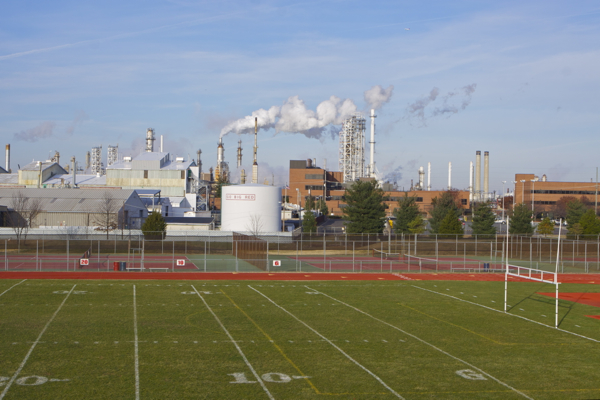
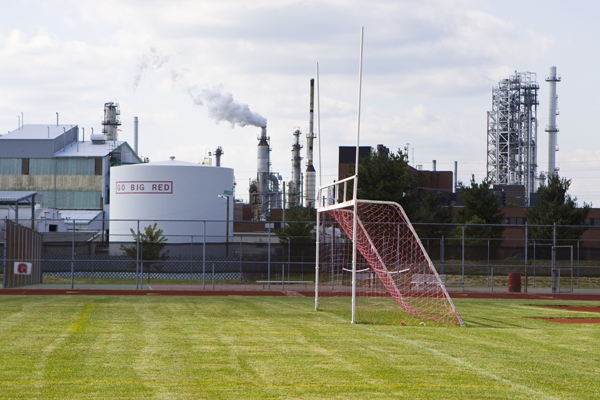
view from the bleachers - Paulsboro HS

view from the bleachers - Paulsboro HS


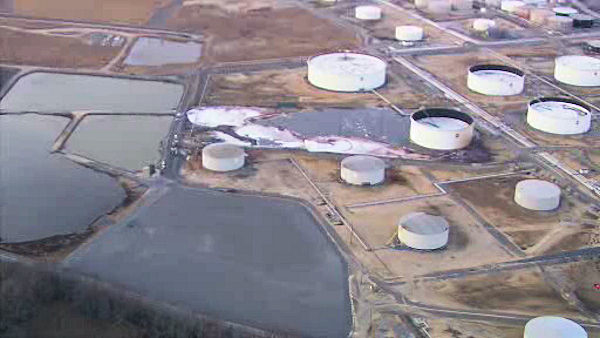
(source: Philly ABC news helicopter)

view from the air (source: Philly ABC news helicopter

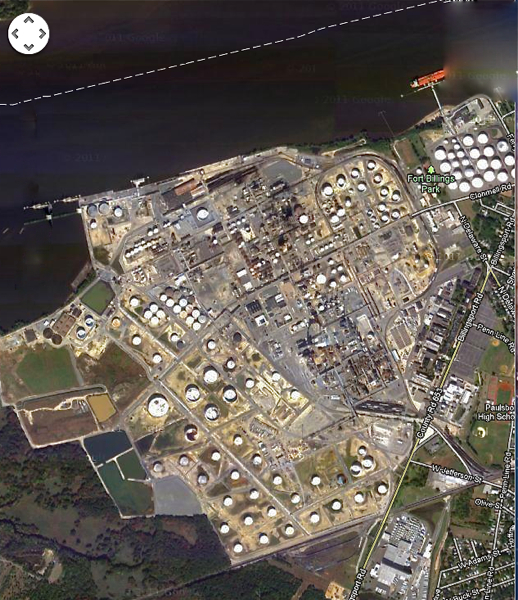
Paulsboro Refinery on Delaware River (Google maps)

Paulsboro Refinery on Delaware River (Google maps)

Categories: Uncategorized Tags:

Only DEP “Red Tape” Prevented an Oily Black Delaware River

February 25th, 2012 1 comment

Paulsboro Refinery and DEP Should Face Some Tough Questions

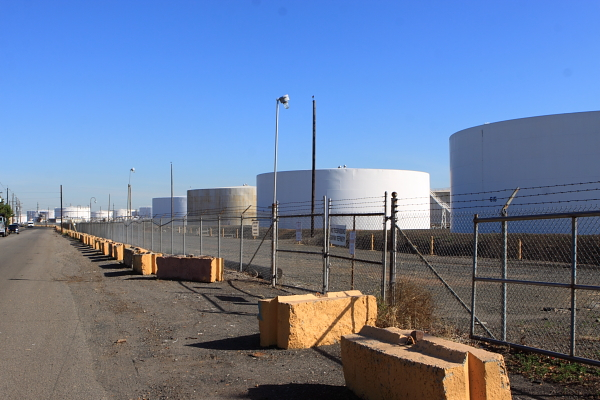
tanks at Bayway Refinery (Linden, NJ)

tanks at Bayway Refinery (Linden, NJ)

The Delaware River just dodged an oily bullet. Here’s why.

The attack on DEP and environmental regulations as “job killing” and “red tape” is led in NJ by the Christie Administration, but several Democrats in leadership of the party share those views.

Ironically, in the Paulsboro refinery spill and Sunoco pollution cases, those views are shared by Senate President Sweeney and Assemblyman Burzichelli, in whose district the those oil refineries are located.

As expected, the local press coverage of the Paulsboro refinery spill basically just printed the DEP press release, again failed to ask tough questions, and whitewashed the whole episode.

So, I thought I’d provide some information regarding the NJ State program that regulates the storage of oil and petroleum products to enable some tough questions.

Based on this information, the refinery and DEP should be asked a number of questions about the enforcement of the Paulsboro Refinery’s Spill Response Plan (see 10 questions below).

That DEP regulatory program – known by the acronym “DPCC” –  is the only thing that prevented an environmental catastrophe from resulting from the oil spill.

Instead of the 6.6 million gallons that spilled running off into the nearby Delaware River, the spill was contained in a diked 12 million gallon capacity “secondary containment” area.

Spill secondary containment areas are mandated by the DEP’s DPCC program – technically known as the Discharge Prevention, Containment and Countermeasures program.

The NJ DPCC State program is more stringent than federal requirements, is strongly opposed by the powerful oil industry, and is a preventative program that was not based on any cost benefit analysis.

It therefore would never have been enacted by the Christie Administration under Executive Order #2 and the Red Tape Initiative.

The DPCC law would never be passed by the current crop of Democratic leaders in the Legislature, for those same reasons.

So, this spill is perfect example of the kind of risks the are being created by the regulatory dismantling now underway at the Christie DEP and the Legislature.

Ten Questions for DEP and Paulsboro Refinery

The context for these questions is the fact that DEP stresses PREVENTION of spills:

With currently available cleanup technology, it is often not possible to recover all, or even most, of the hazardous substance released during a discharge. Therefore, prevention of discharges is a primary goal of these rules. In those cases where a discharge does occur, discharge response and cleanup must be swift and effective, particularly where ESAs are involved. If the substance that is discharged is not contained or recovered, that substance can remain in the environment, causing damage over the long and the short term.

1) when was the facility last inspected – what were the results? What is the facility’s compliance history?

2) was the broken pipe that caused the release structurally sound and in good condition, how old was it, and when was it last maintained;

3) does the secondary containment at the refinery have liners to prevent groundwater contamination? If not, will DEP mandate installation at all existing containment areas?;

4) what are the air monitoring results for EPA regulated “Hazardous Air Pollutants” (HPA’s);

5) what are the health effects for HAP’s ;

6) what are the groundwater monitoring data – are there violations of groundwater quality standards? If so, for what pollutants? Are they being cleaned up?:

7) Has DEP evaluated subsurface gas migration and vapor intrusion into nearby buildings? What are the results?

8 ) How much contaminated soil will DEP require be excavated as part of the spill cleanup?

9) How will storm water runoff to the Delaware River be prevented? How will the cleanup and revised spill containment systems prevent oil and hazardous substances from being washed into the Delaware River by floodwaters, as required by DEP regulations (NJAC 7:1E-2.9); and 1

10) What is DEP proposed enforcement fine and when will that fine be collected?

Background Info

According to DEP:

The Discharge Prevention Program works to forestall the release of hazardous substances and petroleum products to the environment, thereby protecting natural resources and public health before problems occur. The program centers on sound management practices that are considered essential when working with hazardous substances: training employees who handle such materials, periodically inspecting storage tanks, assuring that adequate secondary containment is in place, and developing standard operating procedures for routine operations and maintenance. The program also works to ensure that response plans, trained personnel and emergency equipment are at hand should an incident occur. The Program is often referred to by the acronym “DPCC,” which refers to one of the preparedness documents that major facilities develop under the Program, the Discharge Prevention, Containment and Countermeasure plan.

The current DPCC program operates under regulations adopted by the Corzine Adminsitration. The Paulsboro spill may have been affected by changes made in 2006.

Corzine DEP Commissioner Lisa Jackson bowed to oil industry pressure and EXEMPTED EXISTING OIL STORAGE TANKS from requirements to install liners at secondary containment systems. Liners are needed to protect groundwater from spills.

The DEP DPCC rule proposal made this clear::

N.J.A.C. 7:1E-2.6(c)3i through iii exempts existing secondary containment or diversion systems for existing aboveground storage tanks from the requirement that they be made of or lined with impermeable materials, maintained in an impermeable condition. In the past, the Department accepted a statement from the owner or operator that existing secondary containment for an existing tank could protect the groundwater, in accordance with N.J.A.C. 7:1E-2.6(c)3i through iii. Recently, the Department has requested that owners or operators prove that they can protect the groundwater in the case of a worst case leak into a secondary containment system that does not meet the definition of “impermeable.” In several cases, when actual soil permeability measurements are made and the actual depth to groundwater is considered, data submitted to the Department indicated that the groundwater would not be protected by the existing secondary containment system. Therefore, the Department is proposing to amend N.J.A.C. 7:1E-2.6(c)3i to clearly state that the Department may require the owner or operator of the facility to provide proof that an existing secondary containment system has the ability to protect groundwater, including soil permeability testing (a test used to determine how quickly a substance will move through the existing soil), knowledge of depth to groundwater in affected sections of the facility, and information on how long it would take to clean up the contents of the largest tank within the system. This information can be used to directly determine whether the groundwater will be affected or not.

Categories: Uncategorized Tags:

Another Major Oil Spill at Paulsboro Refinery

February 24th, 2012 8 comments
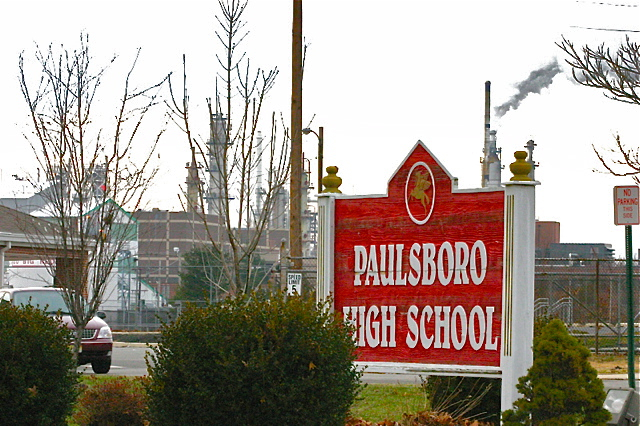
refinery in the back yard of High School

refinery in the back yard of High School

Do Sweeney and Burzichelli Still Hate DEP Regulations and Red Tape?

Late yesterday, DEP issued a press release that just hit my in basket announcing a major oil spill at the Paulsboro refinery.

As is typical, DEP is downplaying risks – the press release reads as if it were written by the oil company. There is no mention of the school just feet away.

12/P16) TRENTON — A large spill from an oil tank at the Paulsboro Refining Company facility in Gloucester County is not expected to impact the Delaware River or local water supplies. Air monitoring also indicates there should be no health effects from odors caused by the spill.

… As of 4:30 p.m., 157,000 barrels — or about 6.6 million gallons — of oil had leaked into the emergency containment area. The tank holds 286,000 barrels of oil, or about 12 million gallons. The emergency containment area, essentially a large berm surrounding the tank, is designed to hold 377,000 barrels in the event of an emergency.

We called the “Community Information Line” and all we got was a tape message by the Paulsboro Refining Company – almost like an advertisement! I wanted to find out if they’ve closed the school.

Has DEP now privatized community communication too? I doubt Paulsboro Refining Company will tell the public about my concerns.

The facility has a history of spills, a pattern of operating “upsets”, and existing air releases and air toxics problems we’ve written about, see:

I’ll check the press and see what the status is and if the school issues got covered.

With Sunoco closing and leaving pollution behind and Paulsboro polluting, I wonder if Senator Sweeney and Assemblyman Burzichelli still  hate all that Red Tape and are still supporting rollbacks to environmental regulations

And of course, the fold by Legislators on spill liability is involved as well.

  • Oil Spill liability cave - S2108

A bill drafted in response to the Gulf of Mexico oil blowout, that would appear to eliminate the cap on liability for oil and chemical spills, is up as well.

While some may see this as a positive, don’t fall for the Trenton Kabuki.

Make no mistake, it illustrates a total collapse by legislators – on a bipartisan basis – to the powerful lobbyists of the chemical and oil industries.

The introduced version of the bill was serious but the final version is now a corrupt and cynical joke.

Legislators gutted the bill by exempting inland oil and chemical facilities and narrowing the bill to spills ONLY from a drilling platform!. There are no and never will be any drilling platforms in NJ or off the NJ coast)

So if an oil tanker spills in the Delaware River – or a chemical plant blows up and kills nearby residents, they will have their liability capped at only $50 million.

For the ugly details on all that, see:   Gulf Blowout Prompts NJ lawmakers to Seek Increase In Polluter Liability To $1 Billion

pb2

Categories: Uncategorized Tags:

Christie DEP Adopts T&E Rollbacks – Sanitizes Criticism

February 24th, 2012 1 comment

Christie DEP Press Office Grows More Orwellian by the Day

New Species of “Special Concern” Provides Cover to Deregulate Habitat

[Intro Note: we wrote about this back in Jan. 2011 when the rule was proposed - see: DEP To Abandon Habitat Protections To Promote Economic Development - DEP CEO Martin Approves Controversial Plan Before Public Review]

We’ve already documented that the Christie DEP Press Office has set records for the most press releases issued by any former DEP Press Office (see: DEP Wins Press Prize).

But we now must note that the spin meter rates that same group the worst ever (and to exceed Brad Campbell’s spin and volume is a real “accomplishment”).

The most recent and egregious DEP Press office spin comes on DEP’s recent adoption of new T&E listing rules.

Those rules weaken protections for rare, threatened, and endangered species and remove previous regulatory protections for habitat and thereby open up over 31,000 acres of land to development.

We warned about mounting political pressure on the Corzine Administration to make these kind of listing changes and explained the regulatory implications for habitat protections back in October 2009, focusing on cooper’s hawk (see: DEP Will Delist Threatened Cooper’s Hawk To Promote Development).

And keep in my that the context for the Christie Administration’s new T&E listing rules include

  • failure by DEP to move forward with T&E habitat protection rules recommended by scientists several years ago (during the McGreevey Administration);
  • Christie Administration “Red Tape” attacks on the Landscape Project and regulatory protections for habitat;
  • Christie DEP elimination of habitat protections in the water quality management planning rules
  • Christie’s State Economic Development Plan proposes to eliminate the State Plan policy map and all linkages with DEP functional plans and maps, like the Landscape project maps and WQMP maps.
  • Christie Executive Order #2 attacks on regulations and policy to inject economic considerations into rules and rollback state rules to not exceed federal standards

With that policy backdrop in mind – which should trigger a high degree of skepticism of any DEP claim to be improving T&E protections – and before we lay out some of the substance, let me now show the bureaucratic games DEP plays to spin the impacts of the new rules and sanitize the huge public opposition.

This spin includes attempts to sanitize the huge criticism that was provided by over 2,700 critical public comments, one of the largest volume of comments opposing a DEP rule.

Of course, as is standard practice, DEP’s press release itself makes all sorts of incomplete, exaggerated, and misleading favorable claims.

But, more subtly, DEP’s press release provides a link to the DEP Endangered Non-game Species webpage, where it is almost impossible to find the rule (I couldn’t), instead of a direct link to the rule adoption and response to public comment, and rule proposal documents.

Those key documents are not linked to by the Press Office because that’s where you can see the heavy criticism by thousands of people.

The rule adoption and response to public comment document shows that over 2,700 people and most environmental groups raised strong objections to the rule proposal. Read that document and see how DEP dismissed and now suppresses public criticism.

Similarly, the rule proposal document included key information.

By the DEP’s own admission in the proposal document, the rule changes would dramatically reduce protection of thousands of acres of currently protected habitat, opening up that land for development.

The DEP created a new category of species of “special concern”, but provided no regulatory protections for them or their habitat. This is the fig leaf cover used to fool some conservation groups into supporting the proposal (see comment #22 below, with which I agree).

According to the economic impact statement in DEP own Jan. 18, 2011 rule proposal: (@ page 17-18)

Current mapping of endangered and nongame species habitats used by the Department in administering the above land use rules includes threatened and endangered species occurrences in the Department’s database as of May 2008. The proposed amendments would result in approximately 43,400 acres currently presumed to comprise endangered or threatened species

habitat no longer being presumed to comprise threatened or endangered species habitat. The addition of several species to the endangered species list and/or additions to species assigned threatened status results in approximately 12,400 acres not currently presumed to comprise endangered or threatened species habitat being added to the area of presumptive endangered or threatened species habitat therefore potentially requiring greater protection under the above land use rules. The overall result of the amendments to the lists proposed herein is a net decrease of approximately 31,000 acres of land presumed to comprise habitat for endangered or threatened species.

But the DEP Press Office wants no reporters or the public rummaging around in those documents. They wouldn’t want a reporter to see stuff like this:

2. COMMENT: Several commenters expressed concern about removing species from the endangered and threatened status categories because that will result in a net reduction in acreage that could be subject to other Departmental regulations, particularly land use regulations that make reference to habitat for endangered and threatened wildlife. The commenters noted that these lands serve as habitat for other wildlife, enable ecosystems to function and are important to quality of life of New Jersey citizens.

3. COMMENT: The proposed amendments are inappropriate as they place opening lands to economic development before the protection of critical habitat and preservation of the biodiversity of New Jersey.

4. COMMENT: The proposed amendments would promote more sprawl and overdevelopment, and jeopardize some of the most sensitive areas in the State.

5. COMMENT: The proposed rules fail to approach the conservation of critical species from a landscape context, instead focusing on individual species. The Department should instead be looking at preserving specific habitat types and ecosystems that are or could potentially be habitat for species of concern, threatened and endangered species.

6. COMMENT: The proposed amendments must be stronger to ensure potential habitat is available to species, and that regulatory protections are extended to all species in serious decline.

7. COMMENT: DEP should adopt strong rules that will not only protect existing endangered, threatened and special concern populations, but promote (wildlife) population growth by preserving critical habitat in the State.

8. COMMENT: Instead of weakening the rules, the Governor and the Department should be proposing a law to extend protection for plants.

9. COMMENT: Thirty years after the Endangered Species Act was passed, the State still does not have regulations to protect upland forest and grassland species.

11. COMMENT: The rulemaking process was not transparent: who was involved, what documents were reviewed and how were these decisions made?

12. COMMENT: The commenter received no notice of a stakeholder process or invitation to participate in this process in any way. Governor Christie’s Executive Order 2 is very specific about the need for common-sense regulatory practices, including the requirement for stakeholder input

13. COMMENT: Some commenters used the form letter referenced as commenter letter #48 to make additional comments. Comments received in this manner included comments advocating for preservation of habitats and New Jersey’s natural resources for the benefit of people and their quality of life, for wildlife, and to preserve clean air, clean water and watershed integrity. Further, some of those commenters expressed their concern that development and corporate interests would benefit from the amendments more so than natural resource conservation that is in the public interest.

22. COMMENT: The proposed special concern category is not strong enough to protect populations that are declining in the State because it simply recognizes that those populations are susceptible to increased loss of habitat without affording the species any regulatory protection to prevent further decline. These species should be identified as threatened. The Department should make available the data and threshold levels used to qualify species as special concern rather than threatened.

Categories: Uncategorized Tags:

Two Headed Trout Outs A “Highly Contested” Toxic Debate

February 23rd, 2012 5 comments

trout(source: NY Times)

Idaho Case Echoes US Fish & Wildlife Service and EPA Decisions in Dupont Cleanup

[Update: 2/27/12 – Record’s Suburban Trends writes the story – headline sucks, but the content is not bad:

US Fish and Wildlife Service recommends more testing in Pompton Lakes

Bill Wolfe, of Public Employees for Environmental Responsibility, said, “This is a highly significant move on the part of the FWS and it completely undermines the prior approval because of the statements it makes about the DuPont science, which it calls ‘antiquated and not adequately protective.’

“DuPont has consistently told the public that its cleanup plans reflect sound science and the DEP (NJ Department of Environmental Protection) rubber-stamped that cleanup plan despite the fact that a DEP scientist raised objections,” said Wolfe.

“It is very important that the FWS recommendations be incorporated in the new cleanup plan that the EPA is going to be drafting and that the cleanup plan completely cleans up the site,” Wolfe added.

The New York Times ran an important story today about a dispute in Idaho – a complex science and regulatory policy story made possible only by the visibility and public outrage associated with the discovery and photographs of two headed trout (see: Mutated Trout Raise New Concerns Near Mine Sites (please read the whole thing).

The Times‘ two headed trout selenium story has numerous parallels and direct relevance to the Dupont Pompton Lakes NJ site and proposed mercury cleanup plan (and there is selenium in addition to mercury and lead present in Pompton Lake sediments).

In a stunning coincidence, the Times’ story was released just days after we wrote about some of those same issues and the US Fish & Wildlife criticized the science supporting the Dupont cleanup plan, see:

Maybe the Times’ reporting can embolden an intrepid NJ journalist to write the story here.

So let’s tee that story up for them and look at the parallels:

I)  Bending the Rules – abuse of waivers and exemptions

At the outset, we need to keep in mind that this debate was triggered by the mining industry’s bold attempt to circumvent compliance with regulatory standards via an exemption, falsely claiming that selenium was safe:

… the company’s report concluded that it would be safe to allow selenium — a metal byproduct of mining that is toxic to fish and birds — to remain in area creeks at higher levels than are now permitted under regulatory guidelines. The company is seeking a judgment to that effect from the Environmental Protection Agency.

Industry false claims and waiver and exemption abuse are rampant in NJ, especially under the anti-regulatory Christie Administration who has proposed a total waiver rule.

II)  Scientific Integrity – Biased Industry Studies Corrupt Science

Industry has mounted a systematic attack on science and the regulatory process.

We have written in detail about how that game is played in NJ, e.g. see:

Just last week, the Union of Concerned Scientists issued a major must read report outlining industry’s strategy and tactics: How Corporations Corrupt Science at the Public’s Expense.

The NY Times writes about how that occurred in Idaho:

The service’s review, released last month, was scathing, describing the study as “biased” and “highly questionable.” Joseph Skorupa, the service’s selenium expert, cited a “lack of valid field controls” and the absence of any analysis of the selenium’s impact on reptiles, birds or the 12 other types of fish in the creeks’ waters. Most troubling, he wrote, was that the researchers systematically undermeasured the rate of serious deformities in baby fish, which were pictured only in an appendix.

Dr. Skorupa wrote that the Simplot report did not provide raw data that would enable him to independently calculate deformity rates. He estimated, however, that the level of selenium that Simplot says causes a 20 percent rate of deformity actually causes a deformity rate of a minimum of 70 percent of all fry. Asked about the wildlife service’s findings, Alan L. Prouty, Simplot’s vice president for environmental and regulatory affairs, declined to comment beyond saying that the agency’s review was “totally outside the regulatory process.”

That last quote by Mr. Prouty is highly significant: it shows that industry is trying very hard to keep US FWS objectives, science and experts out of EPA regulatory decisions. We experienced the same thing in Dupont case. Efforts were made to keep US FWS in the dark and then limit the scope of their review. EPA still has not decided how to respond to USFWS recommendations and incorporate them in RCRA permit decisions at the Dupont site.

III)  Sensitivity of Wildlife to toxics

I don’t have a photo of a two headed trout to drive the story, but there is mounting evidence regarding adverse impacts of toxics on wildlife.

Confirming the point I wrote about just days ago about wildlife being far more sensitive to toxic chemicals at lower levels, the Times reported:

The metal can also affect human health, with symptoms including hair and fingernail loss and numbness in fingers and toes. It has been regulated in drinking water since the 1970s.

But the metal is far more dangerous to aquatic egg-bearing animals like fish, birds and reptiles — a fact revealed in the early 1980s when excessive selenium in agricultural runoff resulted in fatal deformities in waterfowl at the Kesterson Reservoir in California, including missing eyes and feet, deformed beaks, legs and wings, and protruding brains.

Adverse effects occur at extremely low levels. There are numerous chemical pollutants that are not currently regulated that raise toxic concerns and many of the toxic effects of those chemicals are not considered in setting regulatory standards (e.g. endocrine disruption; developmental, reproductive, and behavioral effects).

So there are major gaps in the regulatory protection fabric.

IV)  Implications for regulatory standards

The Times story highlights a huge regulatory debate going on behind closed corporate and government doors.

Many regulatory standards are outdated or based on flawed science and do not protect public health and the environment. EPA is reluctant to enforce federal standards on States and State programs do not have the resources or incentives to set their own standards given lax and lagging federal standards.

Yet, industry has a virtual political blockade on new regulations:

The implications extend beyond Idaho. Selenium is a pollutant at 200 of the 1,294 locations designated by the federal government as toxic Superfund sites. And even though its effects on wildlife have been known for decades, federal agencies have not been able to agree on what level should be prohibited. The E.P.A. is currently reviewing federal selenium rules.

In 1987, the E.P.A. recommended that states set limits for selenium at five parts per billion as measured in the water. (States may adopt tougher limits, but if they prefer less restrictive standards they must submit studies and seek approval from the agency.)

Since then, scientists have recommended that stricter limits are needed, but the rule has not been reset. While federal agencies agree that measuring levels of selenium in fish tissue is more telling than the amount in water, after that the consensus breaks down on what level constitutes a safe standard.

Industry is blocking updating standards to reflect current science in order to reduce their compliance costs for polluting activities.

It’s as simple as that.


Categories: Uncategorized Tags:

Living in the Toxic “Threat Zone”

February 23rd, 2012 No comments

“Our well water was really excellent,” Frances Penza said. “But we don’t drink it anymore.” Press of Atlantic City  2/23/12

VI

Toxic "Threat Zones" Have Been Mapped by DEP at Thousands of Sites

The Press of Atlantic City ran a story today with excellent reporting on the recent PEER disclosure that identified  27 NJ sites that qualify for Superfund based on risk, but were left off the Superfund list (see: Group finds site of former Hammonton dry cleaner overlooked for Superfund designation

This kind of media spotlight and warning to people in harm’s way is exactly why we sued EPA to force public disclosure of the Superfund documents.

The Press story tells an all too typical tale in NJ, where residential wells in thousands of homes have been polluted by toxic and cancer causing chemicals. Scores of municipal well fields across NJ have been poisoned and closed as well.

Often, the people drinking that water are the last to know about it.

And in addition to the health risks, they also pay the economic costs as well – either directly, or indirectly through water rates, local property taxes, and lost equity in the resale value of their home.

Polluters rarely pay – and DEP’s anemic “cost recovery” program collects about 5 cents on the dollar from polluters to reimburse taxpayer monies spent cleanup up pollution. This is a scandal waiting to be uncovered.

And now the press is slowly learning and beginning to educate the public that those all too familiar drinking water well problems also include seepage of toxic vapors into their homes.

That process is called “vapor intrusion”. So far, this statewide problem at hundreds of sites has been written about in only a handful  of sites. The Dupont Pompton lakes site is the poster child for vapor intrusion, where 450 homes have been poisoned.

The press has to warn the public, because the polluters and government agencies who know of the statewide scope of the problem are suppressing the information.

DEP is sitting on a keg of dynamite up in Trenton – see the above map. There are thousands of groundwater pollution cases that are mapped like that.

Yet DEP is telling no one about it.

Who will be the intrepid award winning journalist to write this story about living in the toxic “Threat Zone”?


Categories: Uncategorized Tags: