Archive

Posts Tagged ‘DEP’

Business Leaders Grill DEP Commissioner and Key Legislators

October 9th, 2009 Bill Wolfe No comments

[Update: There were about 30 empty seats in the back and there weren't many builder types at the NJBIA event. Chris Christie had a NJ Builders Assc. event the same day. I wonder what Christie promised the Builders? Were those empty seats builders? Or did the entire corporate crowd just migrate from the NJBIA breakfast to the NJBA luncheon?]

NJ Business and Industry leaders met behind closed doors today at posh Forsgate Country Club to press for more concessions on key environmental regulations to promote economic development.
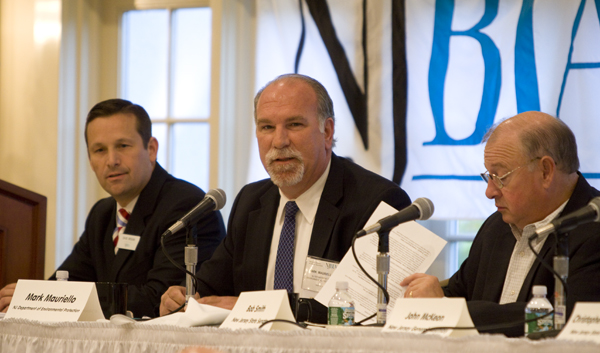
  DEP Commissioner Mark Mauriello speaks to NJBIA at Forsgate CC

DEP Commissioner Mark Mauriello (C) speaks to NJBIA at Forsgate CC – Senate Environment Committee Chair Bob Smith (D-Middlesex) (R) and Dave Brogan (NJBIA) (L)

The NJ BIA event, dubbed “Meet the Decision Makers” featured a panel discussion with DEP Commissioner Mark Mauriello, Senate Environment Committee Chairman Bob Smith (D-Middlesex), Assembly Environment Committee Chairman John McKeon (D-Essex), and Senator Kip Bateman (R-Somerset).

This kind of event – just weeks before a Gubernatorial election – is designed to send a clear political message to DEP to back off enforcement and to continue to weaken environmental regulations to promote economic development. It is another example of how powerful lobbyists for special interests are granted preferential high level access and are able to work behind the scenes to influence policy, gut environmental protections, and politicize science. 

At a time when DEP budgets are slashed, work related travel eliminated, and the undue political influence of special interests is the focus of ethics and corruption investigations across the state, this event sends exactly the wrong message.

A September 28, 2009 email by DEP legislative aid John Hazen – who reports to Mauriello – reveals that Senator Smith demanded specific DEP replies to a series of questions to advance the NJBIA agenda.
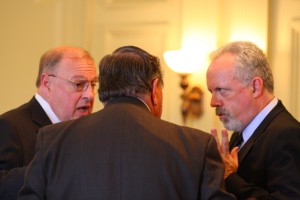
 

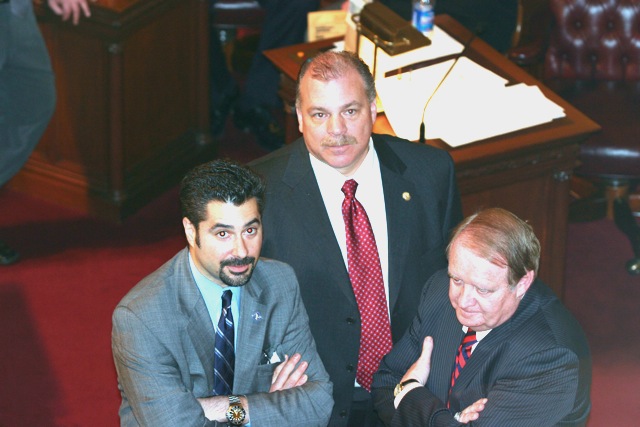
DEP Hazen (R) confers with Senators Smith (L) and Bucco (back facing) before Senate Environment Committee hearing (5/19/08)

DEP Hazen (R) confers with Senators Smith (L) and Bucco (back facing) before Senate Environment Committee hearing (5/19/08)

Hazen solicited responses to the following questions posed by NJBIA and conveyed to DEP by Smith:


 John Hazen 9/28/2009 11:50 AM >>>

On October 9th NJBIA will be hosting Commissioner Mark Mauriello, Senator Bob Smith, Assemblyman John Mckeon And Senator Kip Bateman For A “Meet The Decision Makers Event”.

 In preparation, Senator Smith’s office has contacted me to see if we can provide him with some background/briefing/info to answer the following questions. Can you please review the following and get back to me with a brief writeup on your respective topics? Thanks. 

 1. What are your goals going forward, not only in the Lame Duck Session, but beyond?

 2. What is the status of the Licensed Site Remediation Professional program?  How many temporary licenses have been issued?  What is the status of the board?

3. What is the status of the Water Quality Management Planning process? Where have you seen problems?  How are you dealing with the conflicts arising from the sewer service area maps the department is using? 

4. What is the status of the Science Advisory Board?  What are the first few issues you see them tackling?

5. If the bond act fails, do you see the need for an immediate stable source of funding for open space and farmland preservation?  If the bond act passes are you still contemplating a water tax?

 6. As companies do a better job at lowering emissions, what are the challenges you see in funding the Title V program?  Is it fair to raise fees on companies that are taking steps to lower emissions and improve the overall air quality of the State?

7. What is the status of the State Water Supply Master Plan?

I managed to crash the event and below report the following discussion that ensued. This can give you a sense of the business community’s concerns.

Overall, I was disappointed but not surprised by the lack of vision or leadership on the environment.

former Governor Jim Florio was in attendance

former Governor Jim Florio was in attendance

I was appalled by how willing both DEP Commissioner Mauriello and legislators were to accommodate business demands.  I was shocked by Senator Smith’s remarks about stealing property, property rights, and an all out attack on new DEP Water Quality Management Planning rules. And I was embarrassed by the juvenile bashing and personal attacks on colleagues Dave Pringle and Jeff Tittel.

Following short introductory statements by the panelists, a question (Q) and answer (A) session took Place. Here is a summary.

1. Licensed Site Professionals (LSP) (this new program got the most discussion. NJBIA distributed a fact sheet to members. Here are EPA audits and our take on SRP and LSP)

What is the status? How many license applications?

A: (Mauriello) Irene Kropp has done a wonderful job in developing an entire new program. Nothing being done in the dark behind closed doors – open and transparent process, listening to stakeholders and advisory groups. Looking forward to looking the skeptics in the eye when the program is working.  About 90 applications submitted, 35 approved. Seeking guidance from the Governor’s Office on LSP Board appointments. Program takes effect Nov. 3, 2009 “D Day”. Good news for the environment and really good news for the regulated community.

2. What is the status of proposed rules to delist Cooper’s Hawk as a threatened species? A $40 million project is being held up. Additional projects worth hundreds of millions of dollars are being held up. Economy can’t afford that. DEP drafted rules years ago, but has not proposed. When will DEP propose these rules?

A: (Maurielo) I am familiar with your project. Thanks for the fax describing it. DEP draft rules undergoing legal review. Very close to proposal – expect proposal in next few months. In the meantime, what can the DEP do to expedite your project? Perhaps you should apply for other permits – we will issue.

3. What is status of Science Advisory Board (SAB)? (see this for background on SAB)

A: (Mauriello) The SAB was modeled on EPA SAB. Don’t know if you read blogs [Note: clearly a reference to this post], but our critics are wrong – lots of scientific talent in NJ. I’ve made it clear that SAB will not review standards or drive policy.   160 scientists nominated or self nominated. Despite what blogs say, I had only my first meeting last week with DEP scientists to discuss SAB. Haven’t reviewed names of candidates. (Despite what the blogs say). Looking for diversity and balance. 

4. What is the status of the Report mandated by the Global Warming Response Act and development of regulations to implement the Global Warming Response Act (GWRA)?

A: (Mauriello) GWRA a bold law, but real work needs to be done. DEP implementing RGGI (20% portion of $60 million revenue) on forest and marsh sequestration. 300 application for funding under review. Staff are reviewing comments on the draft report. We just proposed new CAFRA rules to promote solar and wind. Final Report upcoming. No real regulatory focus, more incentives. 

5. What is the status of the Water Supply Master Plan? Why doesn’t NJ go back to US Supreme Court on DRBC allocations, which are unfair to NJ?

A: (misunderstood the question, spent 5 minutes outlining USACOE flood data and reservoir storage; flood hazard regulations; and stream upgrades).

Q: Followup: You misunderstood my question – I am concerned about WSMP science and  models that determine safe yields and 1983 DRBC agreement. Current plan uses 25 year old data.

(there was a later follow-up question on WSMP)

A: (Mauriello) Draft final WSM plan is close. Delayed because DEP waited for new USGS data/model. Plan will identify new population projection growth based surplus/deficit areas, as well as what we need to do to transfer water to deficit areas. “We don’t tell people how to manage water – purveyors have lots of expertise. We try to provide tools for management.”

6. Would you support an extension of the Permit Extension Act, which expires in June 2010? Is such a bill likely to move in lame duck?

A: Smith: Yes

McKeon: Yes

Bateman: Yes

 

Tavit Najarian, consultant, asks about TMDL and DEP's proposed new phoshorus stanadards

Tavit Najarian, consultant, asks about TMDLs and DEP's proposed new phosphorus water quality standards

7.  The Clean Water Act “Total Maximum Daily Load” (TMDL) program lacks a sound scientific basis. DEP just revised the basis for the phosphorus standard from a numeric to a narrative basis. Why? How will this change impact TMDL’s already finished and under development?


A: (Mauriello – did not answer the questions). I agree that TMDL is inefficient and ineffective basis for setting permit discharge limits.  I am looking at the entire TMDL program. DEP spends a lot of time and money developing TMDLs, and then litigating them in court. DEP must then face administrative appeals of permits when the TMDLs are used and incorporated in discharge permits.  The TMDL program will be the first issue I charge the SAB to look into.  I am sure that my science staff will hear about that in less than an hour (laughter).

8. What can DEP and legislators do to stop job loss and loss of production (e.g. recent Sunoco refinery closure)?

A: Smith “We shouldn’t be the problem”

A: McKeon –that’s a complex question involving taxes and labor and the needs of a densely populated state of 9 million people. It will always be more expensive to live in NJ. We can work to expedite permits, but will not “look the other way” and compromise environmental protections which is “short sighted and will poison the future of the state and make it an economic wasteland”.

9. Solar panels are considered “impervious surface” which discourages installation. Why? We need guidance from DEP of new definition of impervious cover to stimulate solar on the ground.

 A: (Mauriello) DEP doesn’t have statewide jurisdiction over IC – in CAFRA and Highlands yes. MLUL has inconsistent definitions too.  Governor Corzine has directed me to make accommodations for renewable energy.

A: (Smith)  – you need a bill to define IC. I will be introducing a bill soon to do that.

10. How can DEP promote sequestration of carbon in forests on private lands?

A: (Smith) – support S713 “Forest stewardship plans” as opposed to “Forest Management Plans”

11. Politics

a) Endorsements – What’s up with environmental groups endorsements? None backed Governor. Can we expect more surprises from them? (lot’s of laughter and jokes about Jeff Tittel and Dave Pringle)

A: Smith: “Anyone here in love with Jeff Tittel, please stand up”

“Live by the sword, be prepared to die by the sword”

A: Bateman: Give Dave Pringle credit.

A: McKeon: DEP has been reasonable on regulations, which is why the environmental groups don’t support the governor.  If Corzine wins, the groups that didn’t endorse will lose influence and credibility.  This will harm the environment because environmental groups will be perceived as “paper tigers” unable to influence voters and the public.  This makes it harder to pass pro-environmental legislation or DEP initiatives. A set back for the environment.

A; Smith – Disagree with Bateman. Tittel/Pringle opposed LSP.  Gov. did the right thing and took them on. There are 200+ environmental groups that disagree with Tittle/Pringle but can’t speak out due to 501C3 status. There are many other groups that support the Gov. but won’t speak out because they are afraid of Tittel/Pringle.   

b) Anti-business climate – what can be done? DEP has worked extremely well with EDA and Gerold Zarro in Gov. Office. What more can be done?

c) Water Quality Management Planning rules – ant-development, takings and property rights

Smith went off. Big problem with WQMP rules. DEP planning to designate areas as non-sewer service areas based on old flawed maps and without knowledge or consent of land owners. This will shut down development. Big problem for land owners, builders, developers.  In designated NSSA, “you’re dead meat”. “My biggest beef is that this steals property rights – we did it in the Highlands.” This is “unfair to property owners”. “All these land owners whose land is about to be designated NSSA” should be aware. Oh, we’re careful not to trigger a legal taking, but we come close and steal property rights. DEP maps and aerial photo’s are flawed. Site in my district whre a COAH project is designated NSSA. I support Sarlo bill to place 2 year moratorium on implementation of new WQMP rules. Provide notice to property owners and opportunity to challenge DEP designations.  “Sorry if this sounds anti-environmental but I’ve already stolen 500,000 acres in this state” (Highlands?). Some NSSA lands broadly designated by mere “possibility” of T&E habitat. “We’ve taken 60% of the land area of the state in Planning Areas 3,4, and 5. You can’t build anything new there.” “If you own property call you county planning board and find out about NSSA designation”.

Mauriello pushed back effectively, acknowledged working to relax deadlines and be flexible, but new rules required because plans are so old and flawed, and don’t consider water supply, wetlands, and other environmental constraints that would prohibit the issuance of land use permits. Working on more notice to landowners. Working on maps – bog turtle habitat suitability improper in some places. TWA permits grandfathered. “My goal is to pre-empt the need for the Sarlo legislative moratorium bill – DEP is making concessions.” (we wrote about the Sarlo bill here)

d) Lame Duck Priorities – Smith:

            Forest stewardship

            ATV registration

            Greenwood Lake Commission fee authorization

            Restrictions on nitrogen fertilizers – Barnegat Bay eutrophication

            Salwater fishing registration

            Dam restoration

Next Session priorities – Smith

            Focus on Barnegat Bay ecosystem (we wrote about Barnegat Bay here)

            Energy bills – renewables

New Front in War On Science – Lawsuit filed to Obtain Smoking Guns

September 29th, 2009 Bill Wolfe No comments

IMG_1493

[Update: Star Ledger covers this story:  N.J. environment group claims DEP denial of records request violated state law ]

We recently warned of a Hostile Takeover of DEP Science – Industry Seeks to Stack Board with Cronies , the latest in an orchestrated War on Science by politically powerful polluters and developers in NJ. The Star Ledger reported on that in a September 20, 2009 story:  Scientists line up to join DEP’s controversial new advisory panel.

IMG_2703Since then, we received additional leaked DEP documents and emails which show that the NJ Chemistry Council (the trade group and lobbyist for NJ’s chemical industries) is seeking to have Dupont and Merck scientists appointed members of a controversial new DEP Science Advisory Board. Similar industry efforts to stack federal Science Advisory Boards during the Bush administration were repudiated by scientists. A Science magazine editorial “Advice without Dissent” hit the nail on the head:

The Bush administration has made some unwise recent moves that undermine the process by which scientists provide advice to the U.S. government. The applicable current law (the Federal Advisory Committee Act), which requires these advisory bodies to “. . . be fairly balanced in terms of the points of view represented and . . . not be inappropriately influenced by the appointing authority or by any special interest,” is more than empty boilerplate….

Instead of grappling with scientific ambiguity and shaping public policy using the best available evidence (the fundamental principle underlying public health and environmental regulation), we can now expect these committees to emphasize the uncertainties of health and environmental risks, supporting the administration’s antiregulatory views. And in those areas where there are deeply held conflicts in values, we can expect only silence. Regulatory paralysis appears to be the goal here, rather than the application of honest balanced science.

In fact, DEP Commissioner Mark Mauriello is meeting with the Chemistry Council this Thursday  to discus SAB appointments. Commissioner Mauriello, in contrast to federal law that mandates balance and prohibits inappropriate influence by special interests,  has virtually unbounded discretion to appoint SAB members.

So, with some of the documents already in hand, I filed an OPRA request to obtain all of them. But in an attempt to keep this chemical industry campaign a covert war, DEP denied the OPRA request.

In response, today, PEER filed a lawsuit against DEP seeking all the documents. We are confident that we will prevail in this lawsuit and that the documents will disclose industry pressure to politicize science at DEP and protect polluters from DEP regulations.

This industry effort must be derailed. Formal industry control over DEP science would have profoundly detrimental impacts on the health of residents and the natural environment.

See below press release for details. 

For Immediate Release:  Monday, September 28, 2009

Contact:  Bill Wolfe (609) 397-4861; Kirsten Stade (202) 265-7337


 Industry Moves to Take Over Jersey Eco-Science Board

DEP Sued to Force Release of Lobbying Messages for Industry-Backed Scientists    


Trenton — Industry wants to pack a new state environmental Science Advisory Board with its own scientists, according to Public Employees for Environmental Responsibility (PEER) which today filed a lawsuit to obtain public records regarding the industry lobbing effort.  Department of Environmental Protection (DEP) Commissioner Mark Mauriello is reportedly making final picks for the 12-member board this week after meeting with the Chemistry Industry Council this Thursday.

 The suit challenges the denial by DEP of an Open Public Records Act (OPRA) request filed by PEER seeking public records related to industry nominees and political lobbying for the Science Advisory Board (SAB) appointments.  The DEP broadly claimed that practically all the requested documents are exempt from OPRA on the grounds that the pending appointments will be treated like candidates for employment, and thus confidential.  Board members, however, are not DEP employees, nor would they be paid.

“DEP cannot make public records secret on the basis of an analogy,” stated New Jersey PEER Director Bill Wolfe who filed the document request.  “Industry has a huge stake in getting friendly scientists on the board that will make the final recommendation on public health regulation.”

In late 2008, former DEP Commissioner Lisa Jackson abolished the Division of Science and Research, based in part on a recommendation of her Permit Efficiency Task Force, chaired by Chris Daggett, now an independent candidate for Governor.  The Science Advisory Board is supposed to substitute for the work formerly done by DEP scientists. 

Thus far, more than 100 nominations have been submitted.  Industry associations have put forward scientists from major manufacturers such as DuPont and Merck as well as from engineers and technical specialists from industry-oriented consultant firms.  This Thursday, October 1st, Commissioner Mauriello, who chooses the board members, will meet behind closed doors with the Chemistry Industry Council of New Jersey, the primary lobby group representing state-based manufacturers.   

 In recent months, DEP scientific studies have been the subject of intense industry lobbying pressure to amend or suppress, on public health topics ranging from the effects of chemicals, such as PFOAs made by DuPont, to cement dust blowing through Camden neighborhoods.  The Administrative Order creating the SAB specifies a conflict of interest review of board nominees but it is not clear what specific rules will be applied, except that members are not supposed to act on matters in which they have a “financial or personal interest” – terms left undefined.

 “It appears that industry will soon be providing the final edits on all scientific work done at DEP,” added Wolfe.  “Without transparency in the selection process, there will always be the doubt that this board will more concerned with political science than environmental science.”

The OPRA lawsuit was filed today on behalf of PEER by Michael Pisauro of the Princeton-based firm of  Frascella & Pisauro, LLC.

 ### 

 Read the PEER lawsuit

 View DEP denial of record release under OPRA

 Review the Science Advisory Board charter

http://www.state.nj.us/dep/sab/

Look at the ongoing war by industry against DEP science

Examine the tactics of DuPont

DEP Abandoned Wood Turtle Habitat Protections

September 21st, 2009 Bill Wolfe No comments

wood_turtle

[10/4/09 Update - Brian Murray of the Star Ledger picked up on the pine snake story today: Frustrated developers are hissing back at a snake 


A colleague advised that the NJ Builders Association recently filed a petition for rulemaking urging DEP to delist pine snake and eliminate certain site specific regulatory protections for its habitat. 


This reminded me of the sorry tale of loss of DEP protections for the wood turtle - and countless other species.  Old news. 

But unless you closely follow the technical discussion on the NJ Highlands email listserve, you probably don't know that DEP abandoned a key regulatory tool to protect critical habitat of the State threatened species, Wood Turtle. 
There were no press conferences, action alerts, sign on letters or other forms of protest by environmental groups. Yes, if one knew where to look, one could find some mention opposing this rollback in the fine print of written comments formally submitted to DEP on the rule proposal by a few conservation groups with biological expertise. But no major political or media opposition was mounted. 
As a result, there was no press coverage to alert the public and no accountability for the DEP politicians who did this vile deed.
Earth Day, 2007 - environmentalist applaud DEP rollbacks

Earth Day, 2007 - environmentalist applaud DEP rollbacks

In fact, you might have  just the opposite impression, because the rule proposal that abandoned protections for the wood turtle - and countless other species – was SUPPORTED by environmental groups. It received VERY FAVORABLE press coverage.

This occurred, despite a January 2007 warning letter signed by numerous groups, strongly urging DEP Commissioner NOT to make the regulatory change.

Dear Commissioner Jackson:

In a late December meeting attended by many of our groups, the Department outlined its plan for a new process to guide the designation of Category One waterways. The meeting afforded only a cursory overview of what would represent a very fundamental change to clean water protections in New Jersey, but did provide an outline of the narrow set of water quality indicators that might serve as the basis for deciding future C1 upgrades. We have serious objections to the proposed designation process and fear that its implementation would strip New Jersey of the ability to adequately protect and maintain its high quality waterways. If enacted, this method would reverse tremendous advances in clean water protection in the state, contradict the commitments made by Governor Corzine, and leave New Jersey without the ability to adequately protect and maintain many of its most deserving waterways.

Signed: Jeff Tittel, Sierra Club, NJEF, ANJEC, Environment NJ, et al

Say What? Here’s that sad tale:

 According to DEP:

Wood turtles are semi-aquatic turtles preferring clear, well-oxygenated streams

surrounded by a mosaic of woodlands, scrub-shrub/herbaceous wetlands, and

successional meadows. In New Jersey, the wood turtle is commonly associated with

water-quality sensitive fish such as native brook trout and brown trout. While once

ubiquitous throughout northern New Jersey, most of the viable wood turtle populations

remain in rural portions of Sussex and Warren counties. Degraded water quality,

habitat fragmentation, road mortality, and predation are the primary factors behind its

extirpation from developed portions of the State. Observational evidence from the

Passaic River suggests that siltation of streams, as a result of stormwater discharge

and urbanization of the surrounding land, can lead to a decline in turtle populations.

 In order to protect the wood turtle and its critical habitat – as well as habitat for numerous aquatic or aquatic dependent species – in 2002, DEP strengthened and greatly expanded water quality regulations – known as “Category One” (C1) waters – to implement the ”antidegradation policy” mandated by the federal Clean Water Act. Federal law requires states to adopt antidegradation policies and implementation procedures. 


Anti-degradation policy seeks to assure that exceptional high quality waters are not degraded by pollution. For the first time, using anti-degradation legal tools, DEP gave these exceptional waters real regulatory protections, by providing 300 foot wide stream buffers (on each side), where soil and vegetation may not be disturbed by major development.


Starting in early 2002, DEP began to classify C1 streams and rivers based upon ”exceptional value” ecosystems. DEP also began designating streams and rivers that drained to reservoirs to protect water supply.


Previously, this C1 classification was limited to a few hundred stream miles that supported naturally reproducing trout populations.


Yet, even despite the C1 designation, historically, those streams were unprotected by DEP regulations. 


The result of the new DEP C1 policy was a huge expansion of over 2,000 designated C1 stream miles and – at 75 acres of stream buffer per mile – thousands of acres of riparian land in new protected C1 stream corridors.  


These DEP regulatory moves were strongly opposed by the NJ Builders Association, pro-development industries, and property owners. Builders particularly opposed the new DEP policy of linking water quality and habitat, and using the “exceptional ecological significance” Clean Water Act policy tool to regulate development and land use to protect water quality.


The wood turtle became a poster child in this debate, because thousands of acres of land were classified as wood turtle critical habitat. Therefore, thousands of acres of such land located in stream corridors could be regulated and made off limits for development via DEP designation of C1 waters. 

One key factor in determining “exceptional ecological significance”, was the presence of wood turtle or critical habitat. According to DEP’s new C1 designation methodology:

The stream’s ability to support water-dependent endangered and threatened species, such

as bog turtle, wood turtle, long-tailed salamander and dwarf wedgemussel was a significant

factor in determining whether a stream qualifies as a waterbody of “exceptional ecological

significance”. (link here)

Between 2002-2003, the following exceptional streams were designated C1 protected on the basis of the presence of wood turtles and/or critical habitat – each designation protected lands in stream buffers. These regulatory moves by DEP triggered major battles with the builders because they blocked large development projects:

In November 18, 2002: Assiscunk Creek; Beaver Brook; Flat Brook; Sidney Brook;   South Branch Rockaway Creek; 

In January 6, 2003: Paulins Kill; 

In November 3, 2003: Harihokake Creek; Nishisakawick Creek; Pohatcong Creek; Wickecheoke Creek; Plum Brook;

Under the new pro-economic development Corzine/Jackson DEP, the legal ability of DEP to designate C1 streams on the basis of wood turtle - and numerous other threatened and endangered species – was lost by DEP in a May 21, 2007 rule proposal where DEP revised the C1 designation methodology. The revisions greatly narrowed DEP’s ability to designate C1 waters and eliminated wood turtle as a basis for doing so.

The Lisa Jackson DEP found that a new method was required as a result of “experience” – read the code for “due to strong oppostion by the powerful development community“:

Based upon the experience gained in the review and analysis of waterbodies for potential Category One designation, the Department is proposing to establish new definitions. These new definitions better define the data and criteria utilized to identify waterbodies that qualify for consideration for upgrade to Category One designation. These definitions are data driven and will better serve to identify waters that are truly exceptional. The Department is proposing amendments to the definition of “category one waters” and introducing new definitions for “Exceptional Ecological Significance”, “Exceptional Fisheries Resource(s)”, “Exceptional Water Supply Significance”, and “HUC 14”. (link) 


The new DEP C1 designation method limited exceptional ecological value to a short list of specific species – if sa species was not lsited, it was not protected. The list did NOT include wood turtle.


Exceptional Ecological Significance – Endangered or Threatened Species (E&T) 


The Department is now proposing that a waterbody with the presence of suitable habitat verified by the Department to support Bog Turtle, Dwarf Wedgemussel, Brook Floater, Triangle Floater, Green Floater, Eastern Pondmussel, or Eastern Lampmussel, with a documented occurrence(s) of at least one of these species verified by the Department are eligible for consideration for Category One antidegradation designation upgrade. To qualify for consideration for Category One status as a waterbody of exceptional ecological significance, requires that the waterbody have suitable habitat verified by the Department to support on of these aquatic dependent E&T species and documented occurrence(s) verified by the Department. These species include several freshwater mussels and Bog Turtle. …

For a detailed description of each species and its habitat see: http://www.nj.gov/dep/fgw/ensphome.htm


For the wood turtle, the fight for riparian habitat protections is over – DEP unilaterally surrendered.


The only protections remaining are case by case, site specific  mitigation in individual land use permits – a formula for extirpation.


End of story.

Obama White House Can Release Visitor Logs – Why Can’t DEP?

September 4th, 2009 Bill Wolfe No comments


Lobbyists sign in at DEP - who were they visiting and what were they discussing?

Lobbyists sign in at DEP - who were they visiting and what were they discussing?

If the White House can release visitors logs, why can’t the NJ Department of Environmental Protection release them? 

 According to CNN breaking news:

WASHINGTON (CNN) — President Obama plans to announce Friday that the White House will release its future visitor logs on a regular basis, two administration officials said.

The announcement follows a legal settlement with the group Citizens for Responsibility and Ethics in Washington (CREW), which had sued the administration for release of visitor logs, the group announced on its Web site.

Since taking office, the president has been criticized for refusing to release some of the logs, including those relating to health care and coal company executives.

The new policy will apply to visitor logs created after September 15 — not to previous visitor logs, according to an administration statement outlining the policy that CREW posted on its Web site. The future logs will be released 90 to 120 days after the meetings, and there are some exceptions.”

Last year, NJ DEP Commissioner Lisa Jackson denied a legal petition to bring transparency to DEP by disclosing who senior DEP managers meet with. Ironically, after leaving NJ to become EPA Administrator, Jackson reversed her NJ position and agreed to post her daily calendar and those of senior EPA managers on the EPA website.

In the wake of recent corruption scandals involving access to and political influence on DEP, that petition  was refiled and is again before current DEP Commissioner Mark Mauriello.  How Mauriello handles that request will be a test of the Corzine administration’s alleged commitment to transparency, open government and ethics reform.

Will press hold the Governor accountable on this issue and ask him about Lisa Jackson’s previous denial?  Will good government reformer Independent Chris Daggett engage the issue in the campaign? Will corruption buster Republican Chris Christie take a stand on transparency at DEP?

We’ll keep you posted.

[Update: The Union of Concerned Scientists has very similar reaction - read the UCS press release here]

Political Pressure on DEP – How The Game is Played

September 1st, 2009 Bill Wolfe No comments


Senator Sweeney (center) consults with Senate President Codey (right) on Senate floor

Senator Sweeney (center) consults with Senate President Codey (right) on Senate floor

First I will lay out the general contours of the issue, and then I will provide the explosive goods. The goods will perfectly illustrate the problem. So bear with me.

It is no secret that Senator Stephen Sweeney (D-Gloucester), Senate Democratic Majority Leader, is a powerful force in South Jersey politics, the Legislature, and the democratic party. Sweeney knows how to wield that power.

It also no secret that Brad Campbell, former DEP Commissioner and one of the brightest environmental lawyers around, is no stranger to how the DEP makes decisions. Campbell has access to and knows how to influence DEP.

Former DEP Commissioner Bradley Campbell

Former DEP Commissioner Bradley Campbell

What is a secret (to the public) and known among only a handful of insiders, is that Sweeney and Campbell have teamed up to pressure DEP to reverse a recent major pro-environmental decision (this link is only a teaser, read on).

Typically, when pro-environment DEP decisions have a major economic impact on a politically powerful interest, those interests work behind the scenes to pressure DEP managers to reverse the decision.  All too often, the DEP Commissioner caves in to the pressure and directly reverses the staff level decision. In other cases, the deal is not so obvious because the data, science and/or regulatory interpretations that formed the basis of the original decision are revised in a way to undermine the original decision. These changes then force DEP to abandon the original decision and the result is that the the corporate interest prevails.

Corporate interests and political DEP managers are enabled to do this under cover of secrecy. Deals are made behind closed doors. The public, the press, and environmental groups don’t even know good decisions were made, never mind that they were reversed due to political intervention. There is no transparency and accountability in the system. (Even without special political influence, DEP data show that over 95% of permits are approved by DEP. See latest DEP permit Report here.

The lobbyists, DEP managers and political appointees, and political dealmakers like things just fine this way.

Anti-environmental economic interests also benefit from a DEP staff that is intimidated and reluctant to blow the whistle, because DEP staff know that DEP managers retaliate and that whistleblower laws are weak. Few are willing to risk destroying their career and livelihood.

That’s why transparency at DEP is so important – and why we are working to enhance transparency at DEP.

That’s why whistleblower protections are so important – and why we are working to strengthen them.

That’s why ethical restrictions to limit political abuses are so important - and why we file ethics complaints  and seek to strengthen ethics laws and their enforcement

This is why we are fighting to stop the revolving door and influence peddling at DEP.

That’s why independent public science and scientific integrity are so important – and why we fight to defend them.

Well, every once in a while, this dynamic is reversed and the bright lights of media and public scrutiny make it very difficult if not impossible for the DEP Commissioner to cave in to political pressure.

I have a perfect example of how this all works:

In an August 20, 2009 letter to former DEP Commissioner Brad Campbell, DEP Assistant Commissioner Scott Brubaker made a scientific finding and determined that:

“[the Delaware Bay] is not appropriate for a large-scale wind turbine project due to…impacts to migratory and other bird populations.” and

“…the Department has determined that we have, over many years of study and evaluation, developed sufficient information regarding the diversity, scope, and importance of avian resources in and around the Delaware Bay.  Based on these data, we conclude that, at this time, this area is not appropriate for a large-scale wind turbine project…” 

This is a fabulous decision. The Atlantic Flyway Council also opposed the project (see 7/28/09 letter) and the State of Delaware raised significant concerns (see letter)

Brad Campbell represents Delsea Energy, who are seeking DEP approval to put more than 100 wind turbines to produce more than 380 megawatts in the state waters of Delaware Bay.

The DEP rejection letter had been preceded by a closed door June 11, 2009 meeting with Senator Sweeney and DEP Commissioner Mauriello. Clearly, Campbell thought he had DEP support, in the wake of the June 11, 2009 meeting with Senator Sweeney and DEP Commisisoner Mauriello. After that meeting, Mauriello and Campbell had a private conversation that led Campbell to believe that he had DEP support for the project, or that DEP objections were minor or technical in nature.

DEP Commissioner Mark Mauriello

DEP Commissioner Mark Mauriello

Instead, the DEP August 20 rejection letter clearly took Campbell by surprise because in an August 25, 2009 personal email to DEP Commissioner Mark Mauriello, Campbell complained:

When you and I spoke, you said to expect a letter from land use suggesting a meeting to review technical concerns about the Delsea monitoring application….Did I misunderstand, or has the Department’s position changed from what you described?…Is it really the Department’s view that private parties will not have the opportunity to collect data that might modify, rebut, or qualify F&W’s broad conclusions about the entire Bay?  I don’t want to protract a debate or impose unduly on your time, but the [August 20] letter is quite different from what I expected based on our conversation.”

So, there it is: a powerful Senator calls DEP on the carpet at his State House office in a private off the record meeting with the DEP Commissioner, the former DEP Commissioner and Delsea Energy.

But DEP scientists are not a party to the deal and object.

Campbell then objects to the DEP decision off the record in an email to the Commissioner.

Typically,  with this high powered political pressure brought to bear, such a decision would be reversed.

But now that folks are watching, let’s see what happens!

Oh, BTW – no way DEP Commissioner Mauriello would meet with Sweeney without the knowledge and approval of the front office – so Governor Corzine’s position on this project needs to be established. Will he back DEP scientists?

DEP Takes Polluters “At their Word” – EPA Audit Rips State Programs

August 31st, 2009 Bill Wolfe 2 comments


DEP Headquarters - Trenton, NJ

DEP Headquarters - Trenton, NJ

Public Employees for Environmental Responsibility (PEER) broke the story that a recent EPA audit of NJ DEP environmental programs ripped DEP’s continuing poor performance and lack of effective oversight of polluters. We thank our friends in DEP for outing this bad news, that both EPA and DEP would have swept under the rug – you never  see this stuff in the avalanche of EPA and DEP press releases.

Perhaps the most shockingly unacceptable finding is that DEP takes polluters “at their word“, without conducting field inspections, sampling, or audits to verify their work:

Finding 8: None of the Site Remediation Program’s bureaus interviewed do any project assessment and/or process improvement beyond data validation, (i.e. no field audits, no split samples, no internal assessments, etc). The EPA assessment team was told that Responsible Party contractors and/or NJDEP contractors are “certified professionals and taken at their word.” (link to report here)

Here’s some of the press coverage:

EPA scolds N.J.’s DEP  - (click for complete article)

Friday, August 28, 2009

By MICHAEL SYMONS
Gannett State Bureau

An audit by the federal Environmental Protection Agency found the state Department of Environmental Protection still hasn’t made fixes promised since 2006 and detailed extensive shortfalls in New Jersey’s toxic-site cleanup [Note: and wetlands and other] program.

In a sense, the report means the EPA — headed by former DEP Commissioner Lisa Jackson — is criticizing the management of the DEP during the years Jackson was in charge. …

Bill Wolfe, a former DEP analyst who is now director of the New Jersey chapter of Public Employees for Environmental Responsibility, said the DEP is failing to meet minimum federal quality and performance standards.

This audit is an indictment of DEP management for failing fundamental tests of competence,” Wolfe said. “Without basic procedures for assuring the accuracy and quality of performance data a public agency cannot even be sure that its shoes are tied.”


EPA Criticizes NJ’s Monitoring of Contaminated Sites (listen to mp3 here)

NEW YORK, NY August 28, 2009 —The US Environmental Protection Agency is citing problems with how New Jersey’s Department of Environmental Protection monitors thousands of contaminated sites. WNYC’s Bob Hennelly has more.

REPORTER: The EPA Region two audit of New Jersey’s DEP says the state lacks basic quality controls to ensure the accuracy of its testing and monitoring. As a result the EPA found “potentially significant vulnerabilities in how the DEP collected data to back up its own decision making“. Bill Wolfe, is a former career DEP analyst, with the Public Employees for Environmental Responsibility.

WOLFE: The point of the audit is that the state has no basis to tell the public that they have the confidence that the decisions that they are making are really sound scientifically and actually protect the public health.

REPORTER: A DEP spokesperson says the agency is still reviewing the EPA findings. The federal review covers the time that current EPA Administrator Lisa Jackson was in charge of the New Jersey’s DEP. Her office had no comment. For WNYC I’m Bob Hennelly.


Report: ‘Significant shortcomings’ in state environmental agency
Thursday, August 27, 2009 
BY JAMES M. O’NEILL
The Record
STAFF WRITER

A federal audit of New Jersey’s Department of Environmental Protection identified what it called “significant shortcomings” in how the DEP operates, especially in the division that handles contaminated site cleanups.

The DEP’s site remediation program doesn’t provide proper oversight of contaminated site cleanups because program officers don’t follow up with field audits or internal assessments, according to the federal Environmental Protection Agency report, released Thursday.

The EPA faulted the DEP officials for failing to verify what the private contractors of polluters told them about site cleanups. The DEP officials even told the EPA during interviews that the contractors were “certified professionals and taken at their word,” the report said. (link)  


NJ DEP Commissioner Mark Mauriello - on the hot seat

NJ DEP Commissioner Mark Mauriello - on the hot seat

 This latest EPA audit follows a scathing 2008 EPA Inspecor General’s Report that prompted EPA to take over a number of toxics site cleanups due to years of failure by DEP - see EPA IG Report here.

Will DEP Commissioner Mauriello announce reforms? Will EPA have the balls to strictly oversee DEP and enforce federal laws? Will the Governor or the legislature conduct oversight? Will Chris Daggett, that alleged champion of reform and former DEP Commissioner, speak out? Will the press do additional followup stories to inform the public about the impacts of this failed oversight on public health and the environrment? Will NJ environmental community engage? 


More shoes to drop in this story – we will keep you posted.


New national mercury research confirms NJ’s experience – another nail in coal’s coffin?

August 30th, 2009 Bill Wolfe No comments
Pennsylvania coal power plant on the Delaware River

Pennsylvania coal power plant on the Delaware River

Think coal: Global warming. Mountaintop removal. Sludge impoundment blowouts. Poisoned waterways. Acid rain. Smog. Unsafe mines. Exploited workers. Devastated communities.

The most recent nail in coal’s coffin?

An important new study by the US Geological Survey was released this week. The study documents extensive mercury pollution due to coal power and provides a huge test of the Obama administration’s commitments to develop strict new mercury emissions controls at the nation’s dirty coal power plants. The key policy issues? The inside political history?

Will EPA Administrator Lisa Jackson propose the equivalent of NJ’s strict State emission standards on the nation’s coal power plants?

What was Christie Whitman’s role in the NJ mercury issue? How did it shape her response as EPA Administrator to accommodate energy and coal interests during the Bush years (recall the Orwellian “Clear Skies” that was slammed by NJ officials)?

Here’s the newes coverage:

WASHINGTON –

No fish can escape mercury pollution. That’s the take-home message from a federal study of mercury contamination released Wednesday that tested fish from nearly 300 streams across the country.

The toxic substance was found in every fish sampled, a finding that underscores how widespread mercury pollution has become.

The study by the U.S. Geological Survey is the most comprehensive look to date at mercury in the nation’s streams. From 1998 to 2005, scientists collected and tested more than a thousand fish, including bass, trout and catfish, from 291 streams nationwide.

“This science sends a clear message that our country must continue to confront pollution, restore our nation’s waterways, and protect the public from potential health dangers,” Interior Secretary Ken Salazar said in a statement.

Mercury consumed by eating fish can damage the nervous system and cause learning disabilities in developing fetuses and young children. The main source of mercury to most of the streams tested, according to the researchers, is emissions from coal-fired power plants. The mercury released from smokestacks here and abroad rains down into waterways, where natural processes convert it into methylmercury — a form that allows the toxin to wind its way up the food chain into fish. (read full story here)

This USGS study also confirms scientific research and regulatory standards adopted in NJ over 15 years ago.

Few are aware of this history. It can provide important insights into the current national policy debate.

Fifteen years ago, former Bush EPA Adminsitrator Chritie Whitman had extensive direct involvement with mercury as NJ Governor. Whitman’s NJ role foreshadowed her actions as head of the Bush EPA, which delayed and then proposed a weak mercury emission rule that was overturned by the courts.

Current EPA Administrator Lisa Jackson served as NJ DEP Commissioner. Jackson was Assistant Commissioner for Land Use when her boss, Brad Campbell led NJ DEP to adopted a strict emission standard for coal plants in 2004. Jackson’s EPA is now considering that same issue and developing a national proposal to regulate mercury emissions at the nation’s dirty coal plants.

So, with the former and current head of EPA both coming from NJ, I’m sure we will hear the standard line about NJ’s environmental leadership.

But instead of the press corps merely parroting this talking point on NJ’s leadership, the press and the public should be doing some digging and asking tough questions.

So, let’s take a closer look at the NJ history in light of the current debate.

The mercury issue first arose in NJ in the late 1980’s in the fight against garbage incinerators. In 1990, Governor Florio Administration issued an Executive Order that imposed a moratorium on garbage incinerators and created a Mercury Task Force. In 1993, the Florio Task Force issued a 3 Volume Report that provided the public health and scientific bases for DEP to adopt what was then the strongest mercury air emissions standards for garbage incinerators in the world. While the initial focus was of the Task Force was on garbage incineration, the Report also announced plans to expand emission standards to coal fired power plants, another major mercury source. At the same time, DEP engaged the Philadelphia Academy of Natural Sciences to study levels or mercury in freshwater fish across the state.

The Florio policy and plans to regulate coal plants were derailed in 1994 by the Whitman Administration and new DEP Commissioner Bob Shinn. Their actions set back NJ for over a decade. It took 10 more years before NJ got back on track and finally adopted standards on coal plants in 2004. Because of that Whitman/Shinn delay, we will be paying for that with our children’s neurological impairment as a result of mercury poisoning.

Shinn was a strong supporter of garbage incineration and personally reversed the Florio policy. Shinn was also close to the state’s recreational fishermen, who were hotly opposed to the fish studies. Whitman was “Open for Business” and politically sympathetic to PSEG and state power utilities that operated coal plans. A major new coal plant was proposed along the Delaware River (Crown Vista). Mercury was a fly in the Whitman/Shinn ointment.

In early 1994, at the start of Whitman/Shinn regime, a DEP study conducted by the Philadelphia Academy of Natural Sciences was leaked to the media and reported widely. The leaked study was page one news. The study documented statewide unsafe levels of toxic mercury in NJ freshwater fish.

Widespread press coverage cast DEP and the Whitman administration in a negative light. In response, Governor Whitman sought to downplay the risks of this study. 

Environmentalists accused the state of ignoring its mercury problem, and the press blasted the Governor.

Whitman responded and compared the mercury in fish risks to the recent public reaction (”scare”) to media reports of the health risks of the pesticide alar on apples. The apple industry suffered huge economic losses as demand fell in response to the alar story. Whitman felt the public’s reaction was unwarranted, and unfair to the apple industry. Whitman sought to avoid a similar situation in NJ.

To do this, the Governor and DEP Commissioner came up with a plan to mislead the public by saying that the Philadelphia Academy study was preliminary and inconclusive. The Whitman scheme relied on a bogus and knowingly false claim that the form of mercury found in the fish was unknown and therefore required further research before taking any action. Whitman and Shinn did not make honest mistakes or minor misstatements.

Whitman’s public statements, extensively quoted in the press, were part of a strategy to falsely inject scientific uncertainty and minimize health risks in order to avoid taking regulatory against specific pollution sources of mercury (garbage incinerators and coal fired power plants). Whitman was denounced by environmentalists in the press for this. When this scientific research was leaked and a coverup strategy memo were disclosed to the public by the press, Whitman not only repeated the lies but also retaliated against a career DEP employee who called her on those lies.

In addition to Whitman being scolded fro her errors by academic scientists in the press, scientists in DEP called the Governor out on her lies – Here is the DEP memo:

STATE OF NEW JERSEY,
DEPARTMENT OF ENVIRONMENTAL PROTECTION AND ENERGY,

March 28, 1994.

CONFIDENTIAL MEMORANDUM

TO: Commissioner Robert Shinn.
THROUGH: Robert Tucker, Ph.D., Director.
FROM: Leslie McGeorge, Assistant Director.
SUBJECT: Information on Mercury in Fish.

Over the past several weeks, it has been observed that information attributed by the press to the Governor’s Office on the issue of mercury in fish has contained some technical inaccuracies. We offer the information in this memorandum for your consideration in providing the Governor’s Office with further clarification of this issue.

As was stated by the Governor’s Office, there are three forms of mercury:
* Elemental Mercury (metallic mercury). This is the type of mercury used in thermometers.
* Inorganic Mercury (mercury salts). An example is mercuric chloride.
* Organic Mercury. Methylmercury is the most important organic mercury compound in terms of environmental exposure.

Contrary to the statements reported in the press, all three forms of mercury are toxic to humans. Elemental mercury is volatile, and it is toxic when breathed from the air; exposure to elemental mercury can cause effects on the central nervous system.

The toxicity of the other two types of mercury (inorganic and organic) can occur through ingestion, which is the exposure route relevant to mercury in fish. Inorganic mercury is toxic to the kidney. Methylmercury, the organic mercury of primary concern, is toxic to the central nervous system. The most sensitive toxic effect of Methylmercury in non-pregnant adults is paresthesia (abnormal sensations in the skin). Methylmercury is also toxic to the developing fetus, and causes defects in the development of the nervous system. This developmental toxicity is the most sensitive effect of exposure to methylmercury.

Of the different forms of mercury, all scientific data indicate that essentially all of the mercury in fish is methylmercury. The most recent and reliable investigation into the occurrence of methylmercury in fish conducted under ultraclean laboratory conditions (Bloom, 1992) showed that almost all of the mercury in the edible portion of fish and shellfish (muscle tissue) is in the form of methylmercury. This study included multiple samples (at least 3) of 15 species. For all species, the average percentage of methylmercury was at least 91 percent of total mercury, and for all freshwater fish species, methylmercury was 96 percent or more of total mercury. These results are generalizable to all marine and freshwater fish.

Information attributed to the Governor by the press indicated that there may be a marked difference in the ease of metabolism of different forms of mercury, and that the toxicity of mercury is-dependent on whether it is released naturally or by man-made processes. Actually, the time required for the body to rid itself of a dose of mercury is generally similar for all three forms of mercury. Additionally, the toxicity of a given form of mercury is not dependent on whether it originated from natural or man-made processes. Any type of mercury released may undergo changes from one form to the other in the environment. The mercury in fish may have come from either source, but the origin of the mercury in the tissue is not relevant to the potential for toxicity to humans.

In summary, there are three forms of mercury. For all intents and purposes the only form of mercury found in fish is methylmercury. Exposure to methylmercury through fish ingestion can pose a significant potential for adverse human health effects.

Mercury in fish may originate from human or natural processes, but this distinction is not relevant from a human health perspective.
The Division of Science and Research has additional information on all of the points mentioned above. We would be happy to discuss these issues further with you at your convenience if you so desire. (1)” [end]

Legal Corruption – Senator Sarlo Shills for Builders

August 29th, 2009 Bill Wolfe No comments
Senator Sarlo (D-Bargen) Chairs Regulatory Oversight Committee (5/1/08)

Senator Sarlo (D-Bargen) Chairs Regulatory Oversight Committee (5/1/08)

The latest corruption scandal in NJ has received widespread press coverage and calls for reform.

Importantly, for the first time, corruption has been linked to its impacts on the environment (see: Bergen Record: Builders call the shots; and DEP E-Mails follow lawmakers request; Star Ledger: N.J. environmental groups call for investigation of DEP in light of corruption arrests; Courier Post: Groups call for Probe of DEP  and Star Ledger editorial: Consider CleanGreenNJ’s call for a DEP government cleanup (the CleanGreen NJ reform platform backed by the Star Ledger can be found here).

Yet, while the FBI “Bid Rig” investigation that led to criminal indictments of 44 state and  local officials – including 2 state Assemblymen – was ongoing, virtually the same corrupt game was going on during this extraordinary hearing of the Senate Legislative Oversight Committee on June 4, 2009

What went on during this Senate hearing is effectively as corrupt as the behavior of  Assemblyman Van Pelt (who bragged “DEP works for me and that he “knew the “right guys,” at DEP and how to “work” the “channels.”) and Assemblyman Smith were criminally indicted for.

Follow the logic – 3 easy steps – and keep in mind that DEP “rules” are LAWS, so what we have here is a State Senator (and Mayor) pressuring public officials to allow violations of law:

Step #1 – DEP explains the large environmental stakes:

“We believe, and the current Rules reflect, that it would be poor public policy to extend sewer service at public expense to subsidize and encourage the development of resources the agency is charged to protect. Promoting the extension of sewers and to threaten endangered species habitats, unique and rare ecological communities, and wetlands just does not make sense to us.”

Step #2 – Senator Sarlo brazenly admits he privately intervened – on behalf of the economic interests of builders – to pressure DEP Commissioner to not enforce laws:

“We actually — this Committee met May 1 of 2008,  [I wrote about this hearing here "Builders Gone Wild"] and we had a series of hearings — on May 1, 2008 — with regard to these Rules [issues discussed here, "Builders Escalate Assault on Environment"]  The Rules were ultimately adopted in July of 2008 and went into effect April of  2009 — of this year. In February and March of this year, I had begun an open dialogue with the Department of Environmental Protection and their Commissioner, sharing some of the concerns of the Legislature with regard to counties following through and having their plans approved. And as we know, there are many counties, as we sit here today, whose plans are not approved. What is the impact on the building community with these plans not being approved?”

Step# 3 – DEP admits they caved into political pressure from Senator Sarlo and will not enforce laws:

 “Senator Sarlo, I know that many present here have expressed concern to you over the draft line, and I know that Acting Commissioner Mauriello has been in communication with you on this issue. Foremost, there was significant concern that the Department would withdraw all future sewer service area on April 7 for counties or on July 9 for municipalities if they did not submit their Wastewater Management Plans. The counties are crucial to the success of this project. We are bound to them in partnership. As you know, the Department has extended the counties’ submission deadlines, and will continue to work with them as necessary and appropriate to see this process through. We have no plans, at this time, to unilaterally withdraw a sewer service area from counties that do not have current Water Quality Management Plans.(page 4-5)

 [Note: DEP put this all in writing, read the DEP concession letter – click here

Now, let’s take a look at the text of the hearing transcript for multiple examples of Sarlo pressuring DEP and cheerleading for builders during that hearing. Whose interest is Sarlo representing? The public? The environment? Your interests? Or the narrow economic interests of the builders, property owners, and investors that fund his dual office holding campaigns (as Mayor and Senator?)

  • SENATOR SARLO: Okay. And I just want to clarify that with Hudson being the only one approved right now — everything else pending, the other 16 pending, and the other four — the other three submitting their sewer authority maps, and Warren not participating at all — currently, today, if a plan is not adopted yet or approved by the Department, are we placing any moratorium on any projects that are currently pending before local boards — land use boards? (@ page 10)


  •  SENATOR SARLO: If there are any projects that currently have been approved, not being built because of the difficult economic times, and then they fall within these restricted areas, how are we going to deal with those projects?  (@ page 10)


  • SENATOR SARLOHave we given the counties a definitive date? I know we’ve– And we appreciate the extension, and I think it’s the right thing to do from a public policy standpoint. But has a definitive date been provided? (@page 11)


  • SENATOR SARLO :… Let me clarify that. Make sure we get that clarified. I live in Woodridge, where I serve as MayorSomebody lives out of state, owns a piece of property in New Jersey, and their property has been clipped from the sewer service area. How is that property owner going to know that his property has been clipped from that sewer service area? He lives out of state and is not paying attention. He’s not going onthe Internet, he’s not paying attention to what’s happening in New Jersey, but he owns a valuable piece of property. (@ page 12)


  • SENATOR SARLO:  I mean, I have a concern that the perception here is, here is government coming in, taking away your rights as a property owner, and you have no say. You don’t have the ability to make a statement or make a say. If you’re sitting on a piece of property, perhaps it’s an investment property for down the road. And then you turn around to try and invest in it, you’ve made an investment, and now your property, in a way, has been devalued. So that is a concern of mine and I’m sure many others in the Legislature. (@page 13)


  • SENATOR SARLO: And just one final question: Are we concerned that– Is the Department concerned that some of these rules may provide local officials with kind of a back-door method to deny an unwanted project in their community? Could they use this to hang over — not-in-my-backyard type of syndrome on a project? Could they say, “Down the road they can amend it, and your property may fall within that area that’s going to no longer be a sewer service area. So we should deny your project now”? Is there any concern by the Department on that — that it could be abused by the local municipalities? (@page 13)